



Beyond tradition and technique, the craft is also gaining renewed relevance
In Damascus Citadel, father and son keep Syria’s pottery craft alive
The family, Nabil Saif al-Din explains, is committed to passing on the craft openly to anyone willing to learn, rejecting exclusivity in favour of preservation.
Tuesday 28/04/2026
Beyond tradition and technique, the craft is also gaining renewed relevance
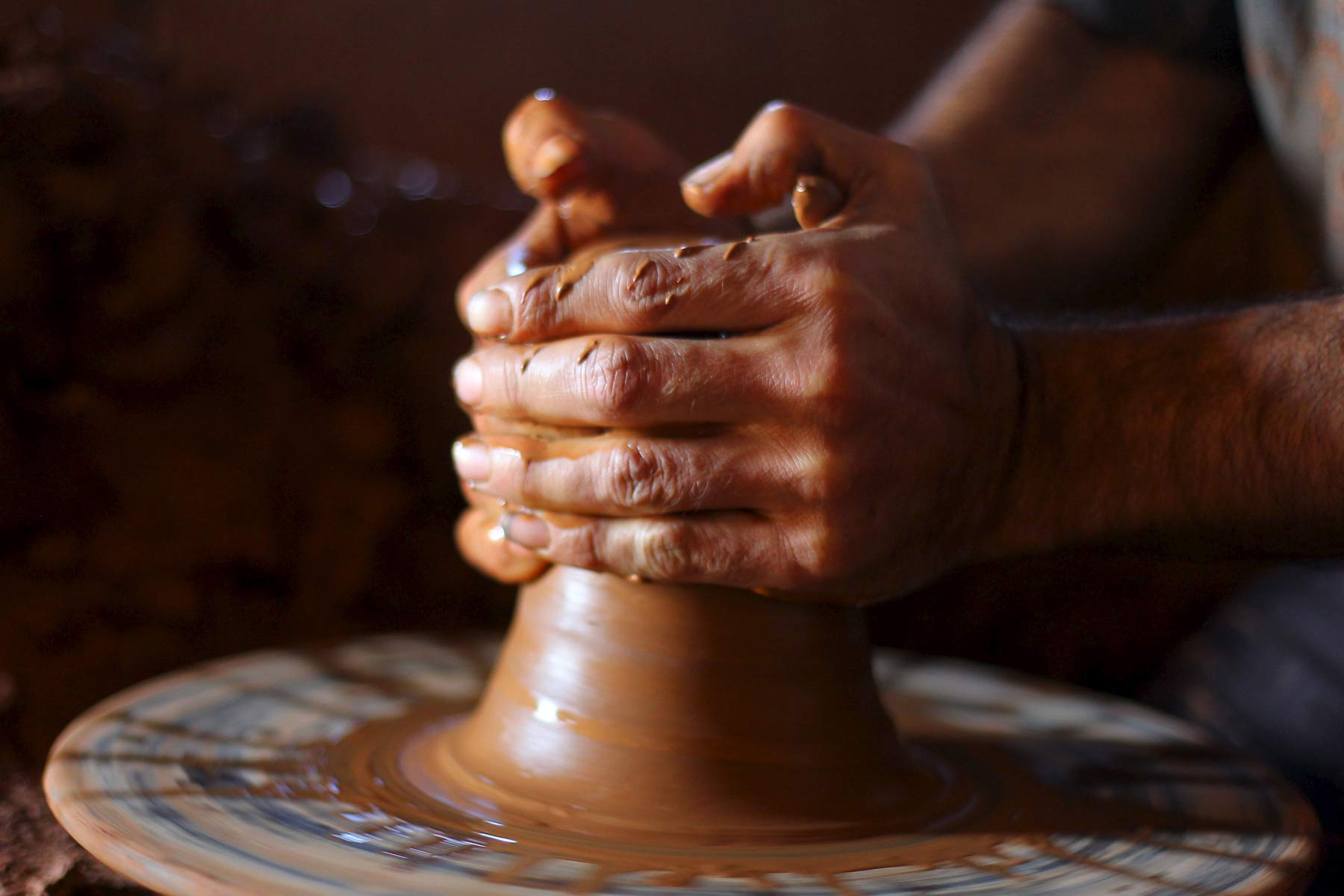
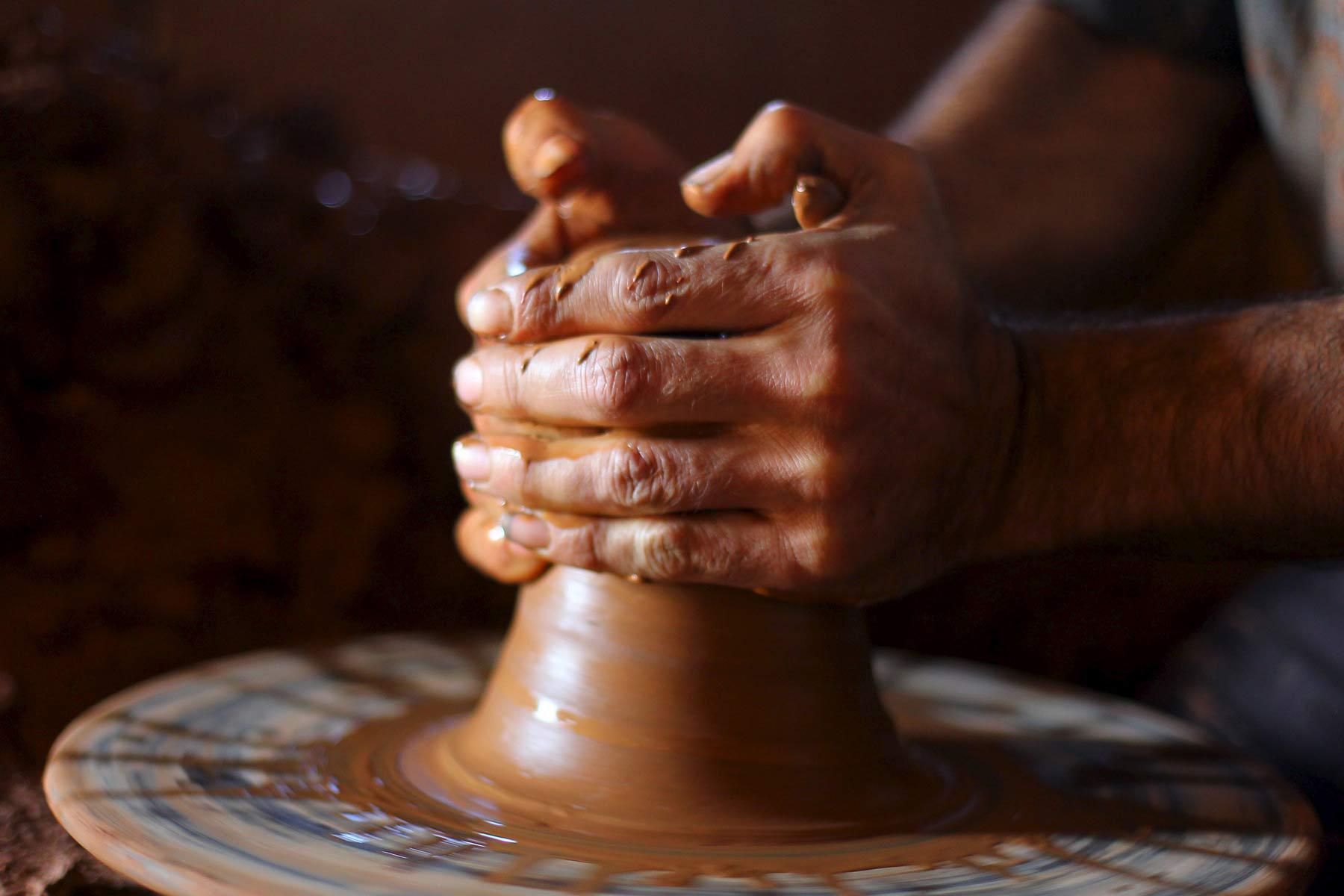
DAMASCUS – In a quiet corner of the ancient Damascus Citadel, beneath the arches of the exhibition “Damascus: A Rose and Heritage,” a small boy sits beside his father, both leaning over a spinning potter’s wheel. Between their hands, a lump of clay slowly begins to take shape, an act at once simple and deeply symbolic, carrying the weight of centuries.
The boy is seven-year-old Ali Saif al-Din, the son of master craftsman Nabil Saif al-Din, widely regarded as a senior figure in Syria’s traditional pottery craft. For Ali, the world of clay is not something newly discovered, but something he has grown into almost from infancy.
His father first brought him close to the wheel at the age of four, when he would simply watch in silence, observing the rotation, the pressure of the hands, and the moment formless earth becomes a vessel. Over time, that quiet curiosity evolved into fascination, and then into a skill that continues to grow.
“The craft is not information that is taught, but a spirit that is absorbed,” Nabil says, speaking with a mixture of pride and responsibility. For him, pottery is not simply a profession but an inherited cultural language.
The family, he explains, is committed to passing on the craft openly to anyone willing to learn, rejecting exclusivity in favour of preservation. In their view, the tradition belongs to everyone, not just to artisans, but to collective memory.
Their work has already travelled beyond Syria’s borders, appearing in exhibitions in Kuwait and the United Arab Emirates, carrying with it the texture of Syrian soil and the imprint of its long artistic history.
Ali, despite his young age, speaks with quiet confidence. “I watched my father many times, then I tried myself,” he says. “I made mistakes, but I learned.” In just two years, he has progressed to shaping bowls, plates and vases, producing pieces according to demand.
Yet what excites him most is not only the finished object, but the moment another child stands watching him work, eyes wide with curiosity. In those moments, he sees his own reflection from a few years earlier.
The craft itself has also evolved. Nabil explains that while pottery once relied entirely on manual preparation of raw materials, modern workshops now incorporate electric tools and mechanical mixers, improving efficiency and reducing waste. Despite this, the essence remains unchanged: earth, water and fire.
The clay is still drawn from natural sources, soil extracted from the land or mountain edges, blended with volcanic sand known locally as “farakh,” then kneaded with water and left to rest in darkness for two days before entering the kiln. Each piece undergoes two firings: the first at around 700°C, and a second after glazing and decoration at approximately 1,100°C.
Beyond tradition and technique, the craft is also gaining renewed relevance. The World Health Organization has recently recommended the use of clay vessels for food preparation, citing their absence of carcinogenic chemicals found in many modern materials. The guidance has encouraged some restaurants to return to pottery as a healthier and more sustainable alternative.
Yet behind the warmth of this revival lies a familiar concern among artisans: preservation. Nabil Saif al-Din calls for stronger institutional support, including regular exhibitions, marketing platforms, and craft incubators that could reduce taxation burdens and protect the craft from decline.
“Syria’s craftsmen are capable of competing regionally and internationally,” he says. “Our product is trusted abroad despite everything we have been through. But we need someone to stand with us.”
Across from him stands another voice of the next generation: 21-year-old Tasneem Ramadan, a fine arts graduate who dreams of furnishing her home entirely with pottery she creates herself, and of developing a distinctive artistic style that carries her personal signature.
She is not an exception, but part of a broader return among young Syrians to traditional crafts, not as nostalgia, but as a search for identity within modern life.
Pottery is among Syria’s oldest known crafts. Archaeological findings at Tell Mureybet in Raqqa reveal clay figurines dating back nearly 8,000 years BC. Across successive civilisations, the craft evolved, reaching a high point during the Islamic period, particularly under the Ayyubids, when richly decorated ceramics flourished.
Today, Syria’s Ministry of Culture, alongside civil society organisations, is working to revive and safeguard this heritage, recognising that what Nabil and Ali shape on the wheel is not merely pottery, but memory itself, turning slowly, like time, in the hands of those who refuse to let it disappear.