


Caught in Iran war crossfire
Gulf states on edge as tanker explosion, missile threats intensify crisis
For now, Gulf leaders are attempting a delicate balancing act: defending their territories, protecting vital shipping lanes and pressing for diplomacy, even as missiles fly overhead.
Thursday 05/03/2026

Caught in Iran war crossfire
DUBAI – A tanker anchored off Kuwait has reported a large explosion on its port side, raising fresh fears for maritime security in the Gulf as regional tensions continue to spiral amid the widening war with Iran.
The United Kingdom Maritime Trade Operations (UKMTO) said the vessel’s master heard and saw a “large explosion” before observing a small craft leaving the area. The incident occurred around 56 kilometres south-east of Mubarak Al Kabeer port.
“There is oil in the water coming from a cargo tank which could have some environmental impact, the vessel has taken on water, there are no fires reported and the crew are safe,” UKMTO said in an advisory note.
Kuwait’s interior ministry later confirmed that the blast took place outside the country’s territorial waters, at least 60 km from Mubarak Al Kabeer port.
The incident underscores the vulnerability of commercial shipping routes at a time when the Gulf is increasingly exposed to retaliatory strikes linked to the US-Israeli assault on Iran. Maritime security has become a central concern for Gulf governments whose economies depend on the uninterrupted flow of oil, gas and trade through some of the world’s busiest sea lanes.
Diplomatic and security tensions deepened further on Wednesday. The US State Department said Secretary of State Marco Rubio had spoken with Saudi Foreign Minister Prince Faisal bin Farhan, discussing “the continued threats the Iranian regime poses to regional stability” and expressing gratitude for Saudi Arabia’s response to the recent attack on the US Embassy in Riyadh.
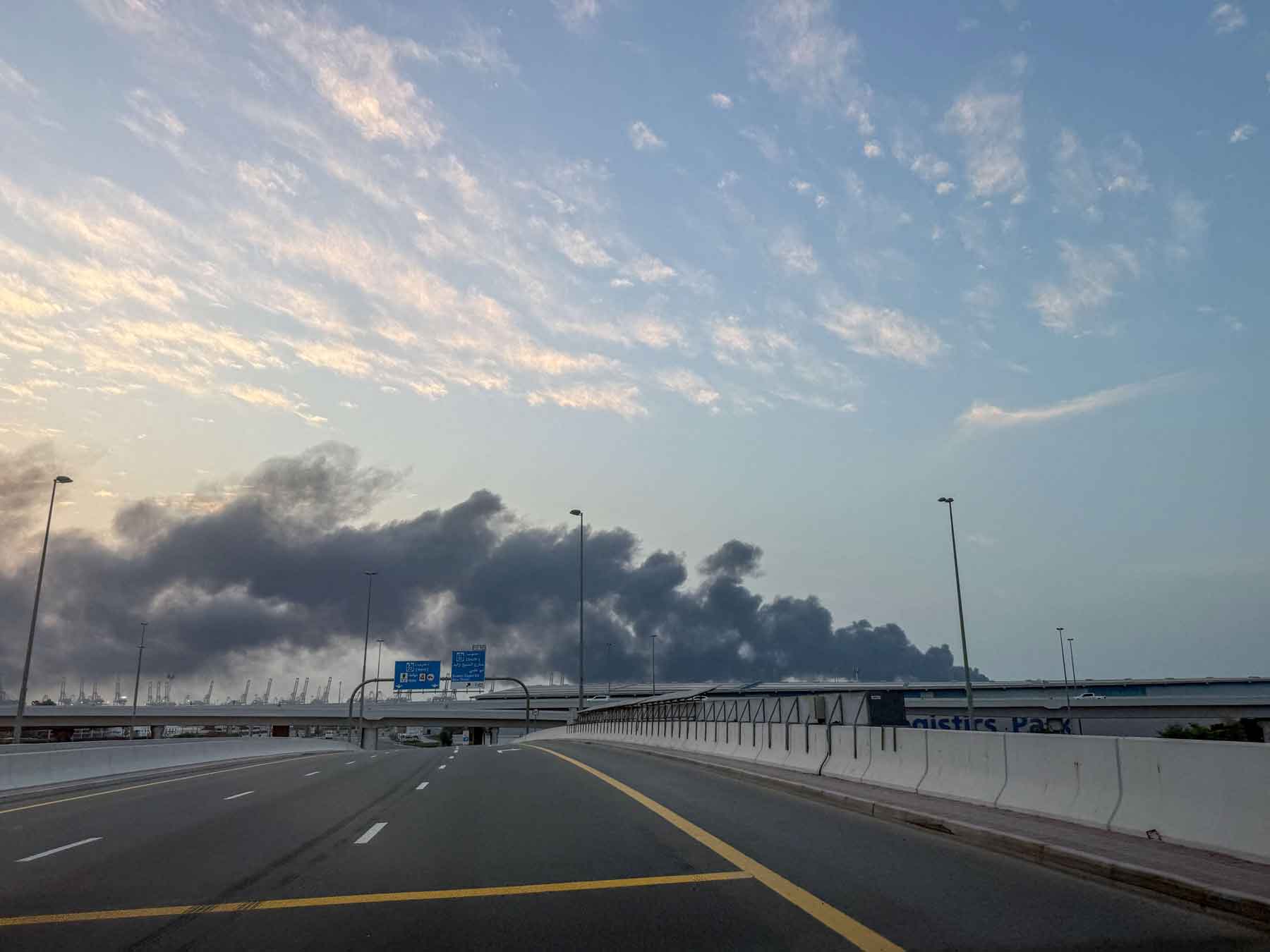
In Qatar, the interior ministry announced the temporary evacuation of residents living near the US embassy in Doha as a “precautionary measure,” with alternative accommodation provided. Meanwhile, Dubai’s DP World said operations at Jebel Ali port were continuing normally after a brief suspension earlier this month amid Iranian attacks on the United Arab Emirates.
For years, Gulf states feared precisely this scenario: an out-of-control confrontation with Iran that would bring missiles and drones to their gleaming cities, disrupt tourism and rattle investor confidence. In retaliation for US and Israeli strikes, Iran has launched more than a thousand missiles and drones at Saudi Arabia, the UAE, Qatar, Bahrain, Kuwait and Oman, according to official tallies. Energy facilities, airports, military bases and even luxury resorts have been targeted.
Explosions have shattered windows in Dubai’s high-rise apartments, while fires have broken out in five-star hotels, a stark reminder that even the Middle East’s commercial hubs are no longer insulated from regional conflict.
Despite hosting US military bases and investing billions in American weapons systems, Gulf leaders are now confronting uncomfortable questions: whether missile defence stockpiles and strategic reserves can withstand sustained attacks, and whether closer alignment with Washington truly guarantees protection.
Observers say the inability of key Gulf states to dissuade President Donald Trump from pursuing maximalist Israeli notions of regime change in Iran exposed the traditional limits of their influence in Washington when it comes to regional security.
The stakes rose sharply this week when the US State Department warned American citizens in more than a dozen Arab countries to “depart now via commercial means,” even as airspace closures limited options for evacuation.
Gulf governments are publicly emphasising de-escalation. Qatar’s foreign ministry spokesman Majed al-Ansari said Doha was engaging regional partners with a focus on calming tensions. The United Arab Emirates has similarly stressed that “the military solution will only lead to more crises.”
Behind closed doors, however, Gulf capitals face a more complex strategic calculus. While Iran remains a longstanding rival and security threat, particularly for Saudi Arabia, some analysts argue that Tehran’s regional weight has also acted as a counterbalance to Israel’s growing assertiveness.
Sheikh Hamad bin Jassim Al-Thani, a former Qatari prime minister, warned that once the war ends, “new dynamics will emerge in the region,” with Israel likely to wield greater influence. He urged Gulf states to avoid being drawn into direct confrontation with Iran and called for greater regional self-reliance.
As the tanker incident off Kuwait illustrates, the Gulf’s worst fear is not merely political realignment but sustained instability, a conflict that disrupts trade, damages infrastructure and undermines the economic model that has underpinned the region’s prosperity for decades.
For now, Gulf leaders are attempting a delicate balancing act: defending their territories, protecting vital shipping lanes and pressing for diplomacy, even as missiles fly overhead and the risk of further escalation looms large.