



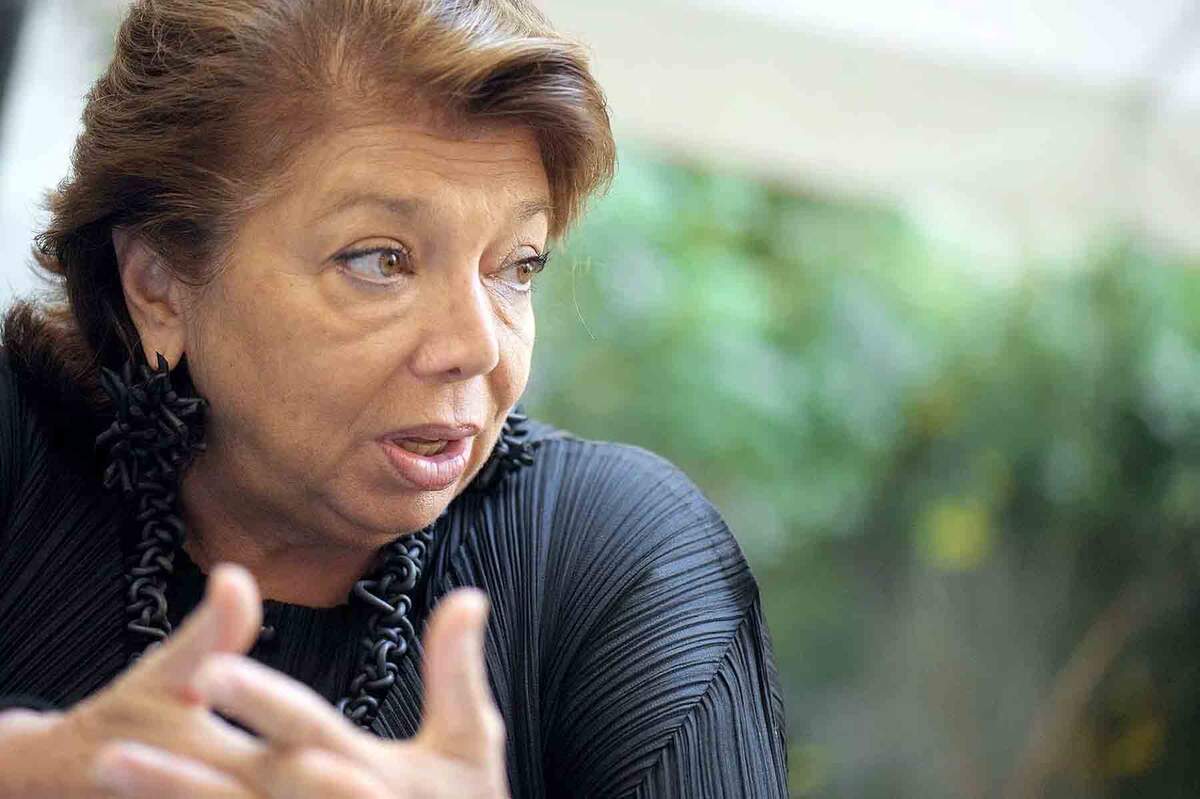
Pioneering diplomat and veteran advocate of Palestinian statehood
Leila Shahid, first female Palestinian envoy, dies at 76
Hussam Zumlot, the Palestinian ambassador to the UK, hailed Leila Shahid as “a towering figure, a role model and one of the most inspiring diplomats Palestine has ever known.”
Thursday 19/02/2026

Pioneering diplomat and veteran advocate of Palestinian statehood
PARIS – Leila Shahid, the first woman to represent Palestine abroad and one of its most prominent diplomatic figures in Europe, has died at the age of 76.
Her death was confirmed on Wednesday by her family. The French newspaper Le Monde, citing relatives, reported that the former Palestinian ambassador to France died at her home in the south of the country. “She died today,” her sister Zeina told Agence France-Presse, without providing further details.
Tributes swiftly followed from Palestinian officials and diplomats across Europe and beyond.
“Leila Shahid, the iconic ambassador of Palestine, has left us,” Hala Abou-Hassira, the Palestinian ambassador to France, wrote on social media. “A tremendous loss for Palestine and for the world that believes in justice.”
Majed Bamya, deputy Palestinian envoy to the United Nations, described her as “a voice for justice, freedom and peace.”
“She is Palestine personified in the francophone world. She’s the one who convinced me to join the diplomatic corps, or as she put it, to have the honour of representing a cause and a people,” Bamya wrote on X.
“I had the honour of serving alongside her, of learning alongside her, of witnessing her magnanimity and compassion, and seeing how she embodies the aspirations and suffering of her people.”
Hussam Zumlot, the Palestinian ambassador to the United Kingdom, hailed her as “a towering figure, a role model and one of the most inspiring diplomats Palestine has ever known.”
“Palestine has lost a seasoned and steadfast voice, one who carried her people’s cause with grace, conviction and unwavering dedication,” he wrote.
Palestinian President Mahmoud Abbas praised Shahid as a “model of diplomacy committed to the values of freedom, justice and peace,” saying “she remained faithful to her people’s message until her final days,” according to the official WAFA news agency.
A life shaped by conflict
Born in Beirut in 1949 to a family originally from Jerusalem and northern Israel, Shahid came of age in the shadow of the Arab-Israeli conflict and the mass displacement of Palestinians following the establishment of Israel in 1948.
She studied at the American University of Beirut, where she met Palestinian leader Yasser Arafat. Early in her career, she worked in Palestinian refugee camps in Lebanon, before moving to Paris in the 1970s to pursue doctoral studies in anthropology. In 1976, she was elected head of the Palestinian student union in France.
Shahid returned to Beirut during the turmoil of the Lebanese civil war and was present at the time of the 1982 Sabra and Shatila massacre, when Israeli-backed Lebanese Christian militiamen killed hundreds of Palestinians in refugee camps — an event that left a deep mark on Palestinian political memory.
In 1989, the Palestine Liberation Organization appointed her as its representative to Ireland, making her the first female Palestinian ambassador. She went on to serve in the Netherlands and Denmark before assuming one of her most high-profile roles: Palestinian envoy to France, a post she held from 1994 to 2005.
Her tenure in Paris coincided with the height of the Israeli-Palestinian peace process and the eruption of the second intifada in 2000. She was also alongside Arafat in his final days before his death in a French military hospital in 2004.
From 2006 to 2014, Shahid served as the Palestinian representative to the European Union, Belgium and Luxembourg, cementing her reputation as one of the most recognisable Palestinian diplomatic figures in Europe. She also directed The Review of Palestinian Studies, a French-language publication examining the history and politics of the conflict.
An unwavering advocate
In one of her last major interviews, with France 24 in September last year, Shahid welcomed France’s decision to formally recognise a Palestinian state.
“I think it’s very, it’s very important, it’s not only symbolic,” she said. “We are reminding the world that it’s [about] self-determination, and we don’t know any other form for self-determination except a state.”
At the same time, she cautioned that recognition alone would not transform conditions on the ground.
“We know that on the ground, we are witnessing a genocide in Gaza and very, very violent, brutal attacks by the settlers in the West Bank,” she said. “We have been occupied since 1967, and you can’t make a state under military Israeli rule.”
On Wednesday, Abou-Hassira said Shahid never stopped denouncing the Israeli occupation or believing that “justice would ultimately prevail.”
Her passing comes, she added, “as Palestine is experiencing one of the darkest chapters in its history.”
“In her memory, we commit to continuing what she started. Her fight is our fight. Her determination is our compass. Her demand for dignity, justice, and truth remains our roadmap.”
For many Palestinians and European colleagues alike, Shahid’s career spanned decades of upheaval and diplomacy. Her legacy, supporters say, lies not only in the posts she held but in the persistence with which she sought to keep the Palestinian question at the centre of international debate.