

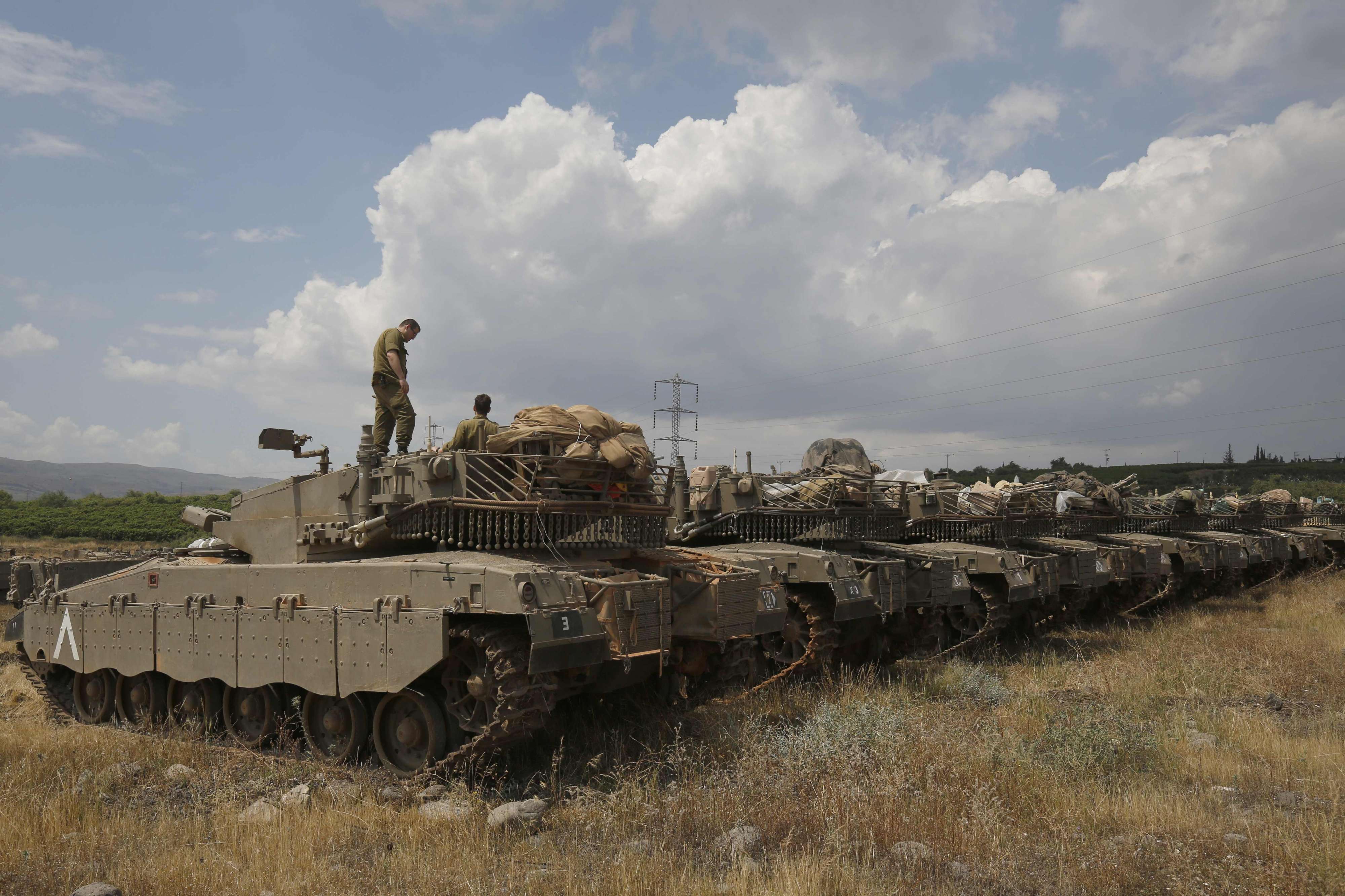
Israeli Merkava tanks are seen in a deployment area near the Syrian border in the Israel-annexed Golan Heights
Syria says Israeli strikes signal ‘new phase’ in war
Damascus says Israel’s ‘aggressive behaviour’ marks new phase of war, increases regional tension after Zionist state hits military targets in Syria.
Thursday 10/05/2018
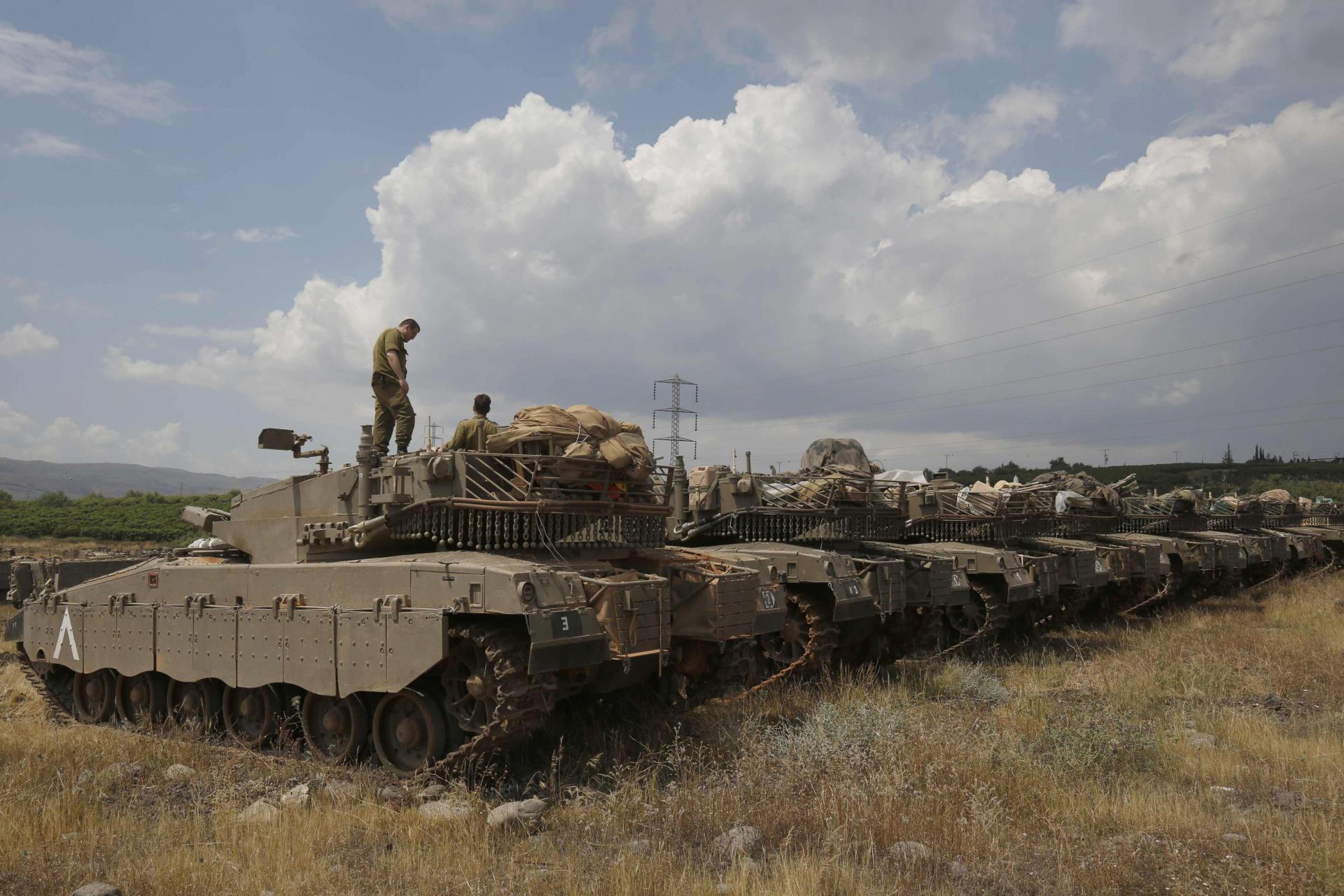
Israeli Merkava tanks are seen in a deployment area near the Syrian border in the Israel-annexed Golan Heights
DAMASCUS - Syria's foreign ministry said Thursday that a salvo of Israeli strikes on its territory marked a "new phase" of direct involvement in the country's seven-year conflict.
In a statement carried by state news agency SANA, it said Israel's "direct confrontation... signals the start of a new phase of the war on Syria".
Israel's army said it hit dozens of Iranian military targets in Syria overnight.
Israel's "aggressive behaviour... will not lead to anything but an increase in tension in the region", the ministry said.
It was "a serious threat to international peace and security", the ministry said.
The Syrian Observatory for Human Rights, a Britain-based monitor, said the strikes near Damascus, as well as in the centre and southwest of the country, killed 23 regime fighters. The Syrian army said three people had been killed.
The deadly strikes by Israel have raised fears of a dramatic escalation in regional conflict, but the situation remains shrouded by conflicting accounts and uncertainty.
Israel says its raids early Thursday were in immediate response to Iranian missiles raining down on the occupied Golan Heights.
But there has been no official statement from Iran, and analysts in Tehran say any missile strikes were conducted by the Syrian military.
Syrian state media reported shelling from the occupied Golan Heights was actually the first to hit the town of Baath in Syrian territory overnight. A senior pro-regime military source in Syria and the Observatory also said Israel had fired first.
Outside observers see a dangerous game of brinkmanship.
"The rules of the game are worked out by trial and error, by push and shove. The pushing and shoving has become more intense," said Heiko Wimmen, of the International Crisis Group.
"We are getting closer to the brink," he said.
Israel has repeatedly warned that it considers an entrenched Iranian military presence in war-ravaged Syria to be a dangerous red line.
In recent years, it has been suspected of carrying out strikes on installations manned by Syrian, Iranian, and allied Lebanese fighters across Syria.
On April 29, missile strikes -- "probably Israeli" -- on regime military positions killed at least 26 mostly Iranian fighters, according to the Observatory.
On April 9, missiles targeted the T-4 air base in the central province of Homs, killing up to 14 fighters, including seven Iranians, two days after an alleged chemical attack carried out by the Syrian regime. Damascus accused Israel of carrying out the strike.
It was only a matter of time before Iran pushed back, said Wimmen.
"The point will come with these actions, where the Iranians will say: we have to push back forcefully, we have to establish deterrence against the Israelis if we want to stay in Syria," said Wimmen.
Israel, too, may feel emboldened by US President Donald Trump's decision this week to withdraw from the 2015 Iran nuclear deal.
"Israel has been chomping at the bit to take a big bite out of Iran's forces in Syria," said Nicholas Heras, of the Center for a New American Security.
- 'A nightmare scenario' -
Israeli Prime Minister Benjamin Netanyahu sees that decision as a "green light to go after Iran in Syria, the consequences be damned," said Heras.
"The Israelis believe they are facing a nightmare scenario right now, where Iran is on the march in Syria, with the intention to start a war that will end Israel," he added.
Syria's south is a complex puzzle: rebels, jihadists, Syrian government troops, Iranian forces, and fighters from Lebanese Hezbollah all have a presence there.
A de-escalation zone agreed last year for southern Syria was meant to reduce violence, but Israel has not been reassured.
Wimmen said two actions could trigger a large-scale confrontation: a missile killing civilians in the Israeli-occupied Golan, or retaliation against Israel by Hezbollah.
But analysts based in Tehran deny Iran is seeking out direct conflict with Israel.
Foad Izadi, of the world affairs department at the University of Tehran, said Iran was not in Syria to fight Israel -- however often the Israelis may say otherwise.
"Iran's deterrence against Israel is done in Lebanon with more than 100,000 missiles, not in Syria," he said, hinting at Lebanese movement Hezbollah's stockpile of rockets.
And Mohammad Marandi, an analyst who was part of Iran's negotiation team leading up to the nuclear deal, said the conflict was more about Damascus than Tehran.
"Whatever happens in Syria happens under the command of the Syrians," said Marandi.
"The Israelis want to make this into an Iran-Israel thing, but it isn't. They are provoking the situation to murder Syrians and Iranians who are fighting ISIS and Al-Qaeda," he added.
- Keeping score -
Israel is thought to have conducted at least three separate attacks against Iranian positions in Syria in recent weeks, with the deadliest killing seven Iranians in a Syrian airbase in the attack on April 9.
There are varying death tolls for Thursday's strikes, but Marandi said Iranians did not seem to have been among the casualties in Thursday morning's attacks.
"All the Iranians in Syria are in contact with their families, and on social media. Their pictures would be on the internet in a couple of hours," the Iranian analyst said.
Still, both sides were quick to claim the clashes had exposed the other side's weakness.
Marandi said most of the rockets from Syria had penetrated Israel's "Iron Dome" defences and hit key sites, including intelligence-gathering centres.
But Israeli Brigadier General Nitzan Nuriel, former director of the counter-terrorism bureau, said the missiles had been intercepted or fallen short.
"Now the ball is in the Iranian side," he said in a conference call with journalists.
"They need to decide if they want to increase the friction and for example ask Hezbollah to do something, or they understand that at this stage they cannot take action against us and need to wait," said Nuriel.
Ultimately, the key to avoiding a more serious escalation amid the fog of war lay with Moscow, which has ties with both Tehran and Tel Aviv.
"Unless Russia steps in, and plays the referee between Israel and Iran, the risk of escalation is certain," said Heras.