

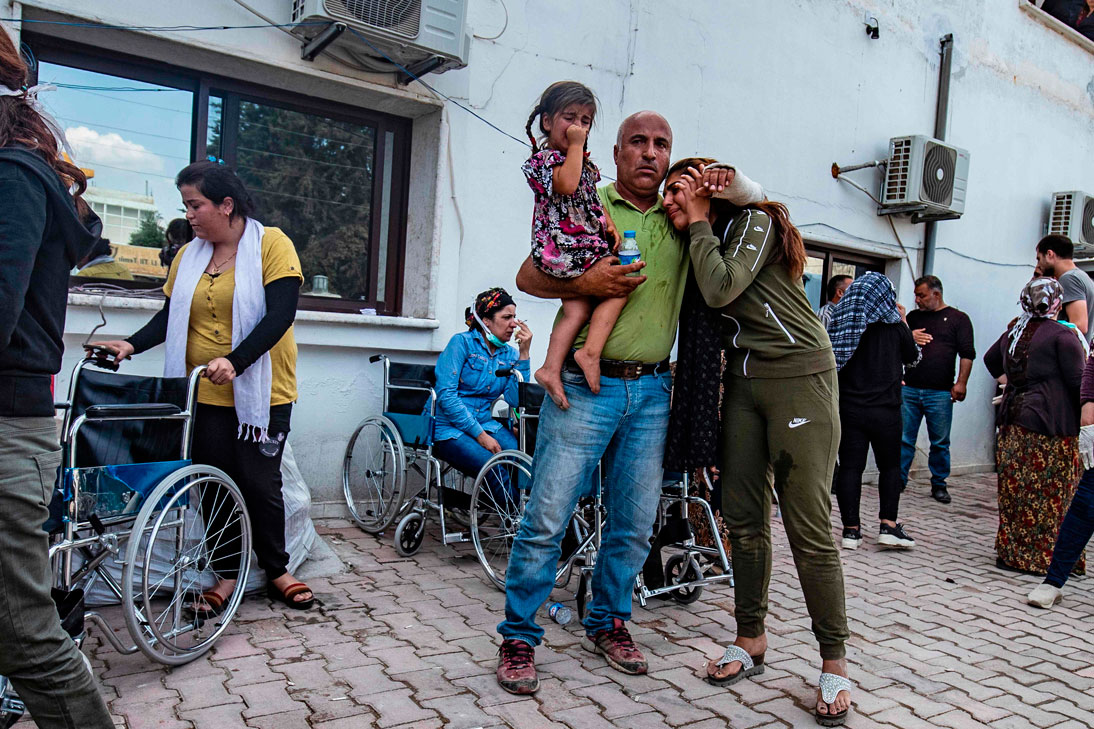
People react as the body of a man killed during Turkish shelling arrives at a hospital in the town of Tal Tamr
Civilians killed by Turkish fire despite ceasefire in Syria
White House officials respond to reports of civilian deaths in Syria by insisting the US was "successful" in reaching a ceasefire deal with Turkey, but that its implementation will take more time.
Friday 18/10/2019
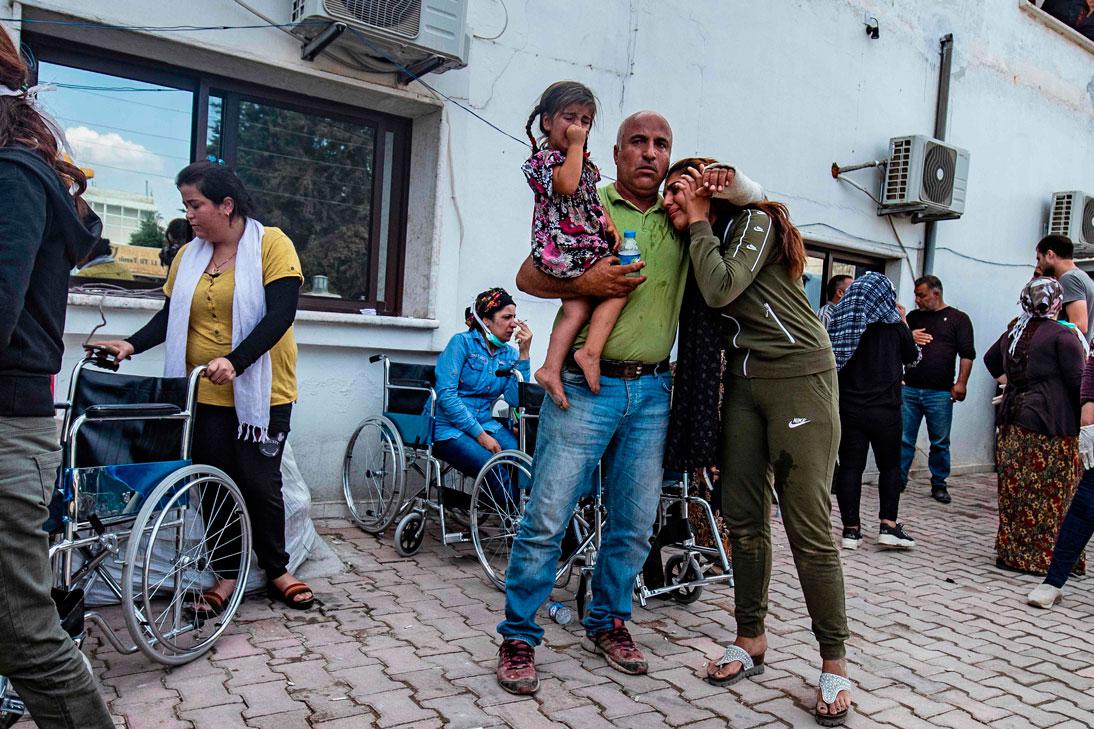
People react as the body of a man killed during Turkish shelling arrives at a hospital in the town of Tal Tamr
TAL TAMR - Turkish-led bombardment Friday killed 14 civilians in northeastern Syria, as Turkey's president threatened to broaden his assault and an hours-old US-brokered deal already seemed destined to crumble.
Rights groups and bemused allies of the US in the anti-IS coalition, meanwhile, continued to heap criticism on US President Donald Trump for his decision to pave the way for Turkey's incursion into Syria's north.
A war monitor said Turkish air strikes and mortar fire by its Syrian proxies killed 14 civilians, appearing to dash the ceasefire announced late Thursday.
That deal was meant to provide a five-day pause for the evacuation of Kurdish fighters from the battleground border town of Ras al-Ain and other areas Turkey wants to control along its border with Syria.
"If the promises are kept until Tuesday evening, the safe zone issue will be resolved," Turkish President Recep Tayyip Erdogan told reporters in Istanbul.
"If it fails, the operation... will start the minute 120 hours are over," he said.
The suspension looked designed to help Turkey achieve its main territorial goals without fighting, but its Syrian proxies continued to clash with Kurdish fighters Friday.
The 14 civilians were killed in Turkish air strikes and mortar fire by allied Syrian fighters on and around the village of Bab al-Kheir, the Syrian Observatory for Human Rights said.
The Britain-based war monitor said eight fighters of the Syrian Democratic Forces (SDF) - the de facto army of the embattled Kurdish autonomous region - were killed in the strikes.
SDF spokesman Mustefa Bali said Turkey was clearly violating the terms of the agreement reached during a Thursday visit to Ankara by US Vice President Mike Pence.
Violation
"Despite the agreement to halt the fighting, air and artillery attacks continue to target the positions of fighters, civilian settlements and the hospital" in Ras al-Ain, he said.
Under the deal, Kurdish forces are required to withdraw from a border strip 32 kilometres (20 miles) deep, clearing the way for a "safe zone" sought by Turkey.
The Kurdish-led SDF had said they were ready to abide by the ceasefire in border territory between Ras al-Ain and Tal Abyad to its west.
Kurdish forces have put up fierce resistance in Ras al-Ain, with a network of tunnels, berms and trenches that held off the Turkish onslaught for a week.
On Friday afternoon, an AFP correspondent on the Turkish side of the border saw a big column of black smoke rise from Ras al Ain, though it was unclear what was burning.
The Turkish offensive was sparked by Trump's announcement of an American withdrawal from northern Syria, leading critics to accuse him of betraying Washington's Kurdish allies.
White House officials said on Friday that the US had been "successful" in reaching a ceasefire deal with Turkey but that its implementation would take time, a sentiment that was later echoed by Trump on Twitter.
The Turkish military and its Syrian proxies - mostly Arab and Turkmen former rebels used as a ground force - have so far seized around 120 kilometres of territory along the border.
More than 500 people have been killed on the two sides, including nearly 100 civilians, while around 300,000 have been displaced, according to the Observatory.
Ankara considers the Kurdish forces to be "terrorists" linked to Kurdish rebels inside Turkey.
Turkish forces and their allies had taken control of half of Ras al-Ain on Thursday when its hospital was hit, trapping patients and staff inside, the Observatory said.
Kurdish authorities sent a medical team to rescue the wounded but it was prevented from entering the town, said Hassan Amin, a director of the hospital in nearby Tal Tamr.
Seven wounded people from around Ras al-Ain made it to Tal Tamr, he said.
The Turkish offensive has been widely criticised, with videos surfacing online allegedly showing captured fighters and civilians being executed.
The Kurds Thursday accused Turkish forces of using banned weapons such as napalm and white phosphorus munitions, a charge Ankara has denied.
Amnesty International Friday accused Ankara's forces and their proxies of "serious violations and war crimes, summary killings and unlawful attacks".
There was no immediate response from Ankara, which says it takes all possible measures to avoid civilian casualties.
Trump has come under criticism in Washington over his handling of the crisis, from Democrats and from within his own Republican Party.
The SDF fought alongside US forces to defeat the Islamic State (IS) group in Syria and Iraq, but Trump argued it was no longer the US role to ensure calm in the region.
Allies caught by surprise
French President Emmanuel Macron, whose country has special forces in Syria as part of the anti-IS coalition, complained he had first learnt of a US troop withdrawal from northern Syria by Twitter.
Macron decried NATO's inability to react to what he called Turkey's "crazy" offensive and said it was time Europe stopped acting like a junior ally when it came to the Middle East.
Turkey's military incursion against the Kurds was widely seen as being greenlit by the US after Trump pulled American troops out of the region, catching NATO's strongest European powers - France, Germany and Britain - by surprise.
It left them incensed, fearing the fighting would cause a security vacuum in which terrorists would escape Kurdish prisons and pose new danger, undoing a Western-led coalition's success in dismantling IS' territorial "caliphate".
The Turkish assault also left European Union powers scrambling to form a coherent response beyond refusing to pay Turkey to contain any new refugee crisis on Europe's doorstep.
"I consider what's happened in the last few days (in northern Syria) to be a serious mistake by the West and NATO in the region," Macron told reporters after a European Council summit in Brussels.
"It weakens our credibility in finding partners on the ground who will be by our side and who think they will be protected in the long term. So that raises questions about how NATO functions."
Macron and French government officials have in the last week warned that the 28-nation European Union risks falling into irrelevance on foreign policy unless it finds a stronger and more coherent way to respond to what they see as unpredictable allies such as Trump's administration.
Discovering through Twitter that the United States was pulling its troops out of northern Syria, which forced France to also withdraw its special forces, made it seem as if Europe was an inconsequential junior ally in the Middle East, Macron said.
"I thought we were in NATO. I thought that the United States and Turkey were in NATO, and then I discovered by tweet that the US had decided to withdraw its troops and pave the way (for Turkey's offensive) in the area," he said. "Like everyone else, I realised that another NATO power had decided to attack partners of the coalition fighting Islamic State."
Macron said it was time for himself, British Prime Minister Boris Johnson and German Chancellor Angela Merkel to act and said they would meet Erdogan in the coming weeks, most likely in London.
"It's important to meet and coordinate between the three Europeans and Turkey," Macron said. "We need to see where Turkey is going and how to bring it back to a reasonable position."
How much the Europeans can actually do to change the dynamics in northern Syria remains to be seen given the balance of power in the region has shifted away from the West.
"The reality I see today is that in the region those who have come out as the winners by imposing their strength are Turkey, Russia and Iran. I'm not sure that was the best strategic thing to happen for Europe and the United States," Macron said.
"It's crazy to do what the Turks are in the process of doing."