

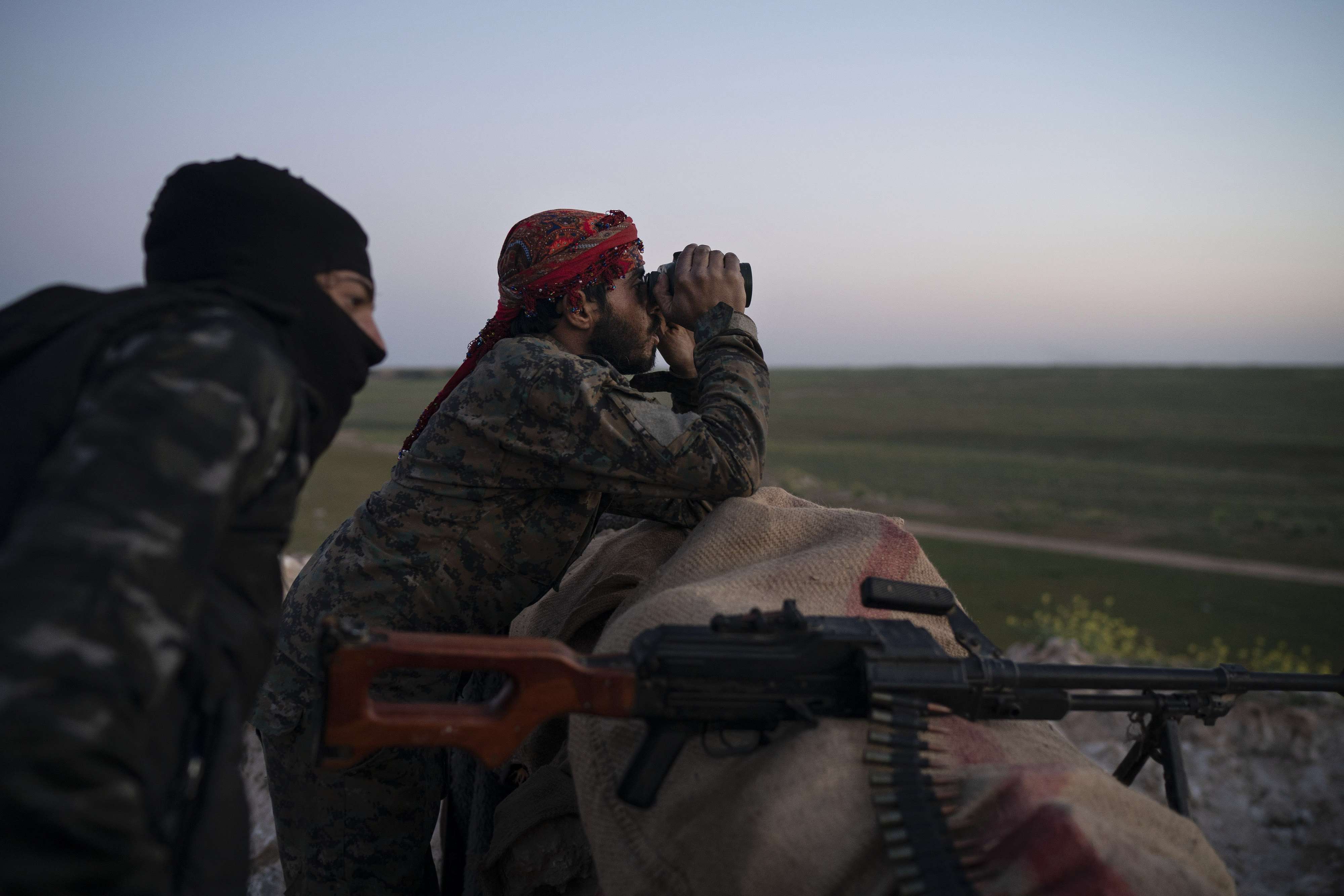
Syrian Democratic Forces fighters survey a position in Baghouz, Syria
Kurdish forces pull back from positions in north Syria
US President Trump says Kurds are "extremely thankful" for the alliance with the US but now have to negotiate their future with Russia.
Thursday 24/10/2019
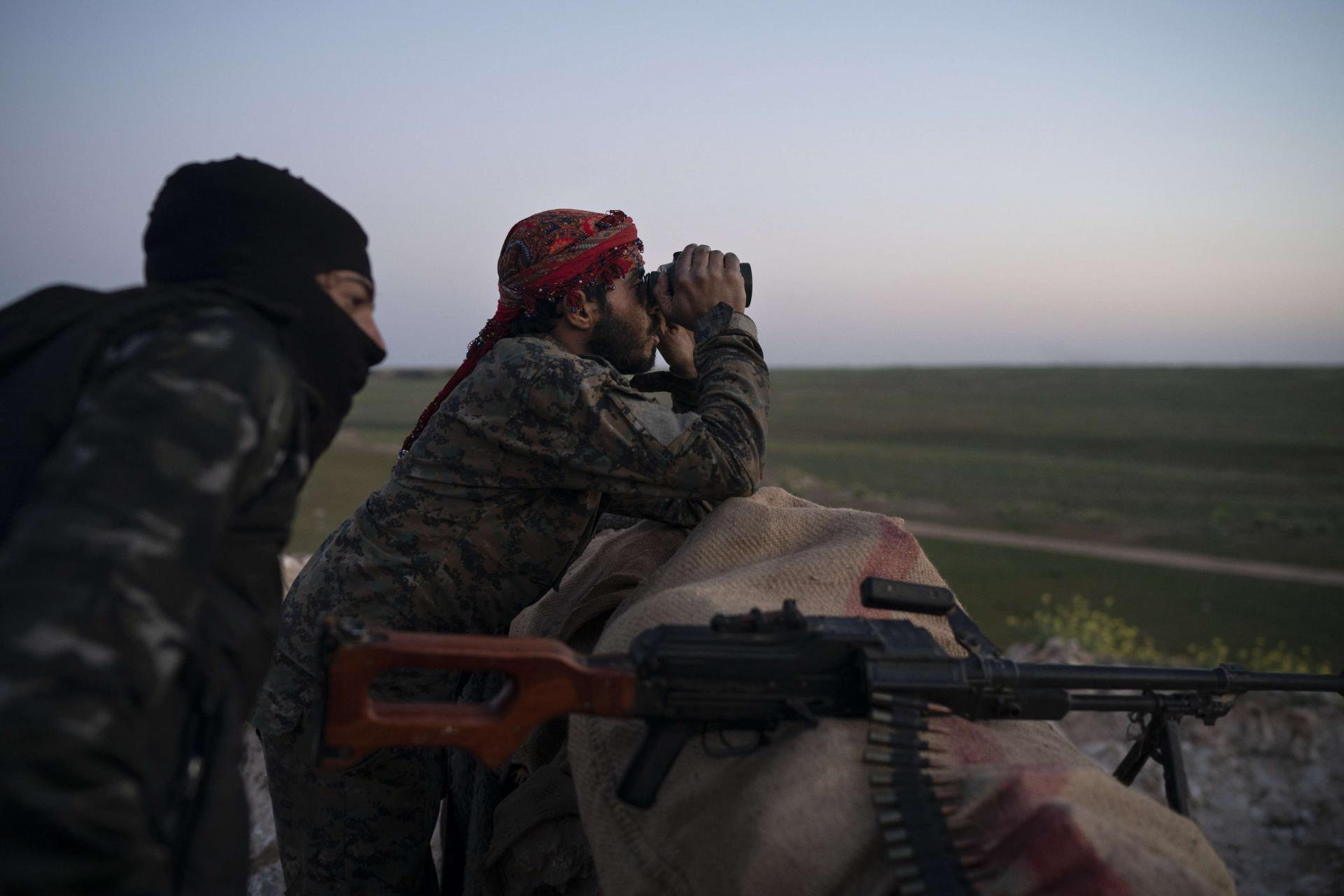
Syrian Democratic Forces fighters survey a position in Baghouz, Syria
QAMISHLI - Kurdish forces in northeastern Syria left several positions along the long border with Turkey Thursday, complying with a deal that sees Damascus, Ankara and Moscow carve up their now-defunct autonomous region.
Russian forces have started patrols along the flashpoint border, filling the vacuum left by a US troop withdrawal that effectively handed back a third of the country to the Moscow-backed regime of President Bashar al-Assad.
US President Donald Trump has praised the agreement reached in Sochi by Turkey and Russia and rejoiced that US personnel were leaving the "long blood-stained sand" of Syria, leaving just a residual contingent behind "where they have the oil".
The deal signed in the Black Sea resort by Syria's two main foreign brokers gives Kurdish forces until Tuesday to withdraw to a line 30 kilometres (19 miles) from the border.
The Syrian Observatory for Human Rights reported that the Kurdish-led Syrian Democratic Forces had pulled out of some areas at the eastern end of the border on Thursday.
"The SDF have withdrawn from positions between Derbasiyeh and Amuda in the Hasakeh countryside," Britain-based war monitor's head, Rami Abdel Rahman, said.
Fighters of the Kurdish People's Protection Units (YPG) - the main component of the SDF - remained in many positions along the 440 kilometre (275 mile) border, he added.
The Observatory also reported clashes near the town of Tal Tamr between SDF fighters and some of the Syrian former rebels paid by Turkey to fight ground battles.
Displacement
Russian and Syrian government forces were deploying across the Kurdish heartland where they are tasked with assisting "the removal of YPG elements and their weapons".
Kurdish forces had already vacated a 120-kilometre segment of the border strip - an Arab-majority area between the towns of Ras al-Ain and Tal Abyad - that Turkey has earmarked for a so-called "safe zone".
Turkish President Recep Tayyip Erdogan, who is embattled on the domestic political front, hopes to use the pocket to resettle at least half of the 3.6 million Syrian refugees his country hosts.
Under the Sochi deal, the area will remain under the full control of Turkey, unlike the rest of the projected buffer zone which will eventually be jointly patrolled by Turkey and Russia.
The SDF withdrawal from that area came after Turkey and its Syrian proxies launched their deadly cross-border offensive on October 9.
The SDF on Thursday accused Turkey and its Syrian rebel allies of launching a large land offensive targeting three villages despite the truce, urging the United States to intervene.
In a statement, the SDF said the attack by Turkish forces on the villages "outside the area of the ceasefire" had forced thousands of civilians to flee. "Our forces are still clashing," it said.
The SDF held Turkey responsible for "deterioration of the ceasefire process", it added.
"Despite our forces' commitment to the ceasefire decision and the withdrawal of our forces from the entire ceasefire area, the Turkish state and the terrorist factions allied to it are still violating the ceasefire process," it said.
Separately, SDF official Mustafa Bali said in a Tweet that the SDF would exercise its legitimate right to self defence.
Mutual accusations
Meanwhile Turkey's defence ministry said five Turkish soldiers were wounded Thursday after an attack by Kurdish fighters in a northeastern Syrian border town.
They were injured after "drone, mortar and light weapon attacks" from "PKK/YPG terrorists" while conducting reconnaissance and surveillance in the Ras al-Ain region, the ministry said on Twitter. It said they retaliated in self defence, but gave no further details.
But SDF commander Mazloum Abdi on Twitter said it was the Turkish-led forces who violated the truce in Ras al-Ain.
"The guarantors of the ceasefire must carry out their responsibilities to rein in the Turks," he added on Twitter.
The events were set to provoke "forceful" discussion at a NATO defence minister meeting in Brussels on Thursday and Friday but Ankara risked little because of its strategic position, diplomats said.
Turkey criticised the US for treating the commander of the SDF as a "legitimate political figure", underlining continued tensions with Washington despite the end of the Turkish offensive in Syria.
Republican and Democratic US senators urged the State Department on Wednesday to quickly provide a visa to Mazloum, so that he can visit the US to discuss the situation in Syria.
Ankara views Mazloum as a terrorist closely linked to the outlawed Kurdistan Workers Party (PKK), which has waged a decades-long insurgency in Turkey.
"We are deeply concerned about the treatment (of Mazloum).... This individual is a senior leader of the PKK, which the United States and others consider a terrorist organization, and a fugitive from justice," said Fahrettin Altun, director of communications for President Tayyip Erdogan.
"He is the subject of an outstanding Interpol red notice. He is wanted for multiple terror attacks targeting the Turkish security forces, a NATO army, as well as civilians," Altun said.
Oil wells
Some 300,000 people have fled their homes since the start of the Turkish offensive and the Kurds among them seem unlikely to return.
US forces pulled back from the border area earlier this month, in a move that Kurdish people saw as a betrayal. Left in the lurch by the US redeployment, the SDF nevertheless seemed to retain some faith in Washington, which still has a huge military presence elsewhere in the Middle East.
Trump said that Mazloum was "extremely thankful" for the alliance with the US but the Kurds now have to negotiate their future with the area's new masters - Russia.
In a phone call with Russia's defence minister and military chief on Wednesday, Mazloum thanked Moscow for "defusing the war in our region and sparing civilians its scourge," the SDF said.
The autonomous Kurdish administration in Syria had hoped that the sacrifices made in the name of the international community to help crush the Islamic State group's "caliphate" would pay off with some sort of assurance that they could keep hold of their autonomous region.
But Trump has been keen to keep a promise to remove his troops from Syria, where IS's "caliphate" was eliminated in March but where conflict continues.
"Let someone else fight over this long blood-stained sand," he said in a White House speech on Wednesday.
That "someone" is undoubtedly Russia, whose status as the main foreign power in Syria is now undisputed, to Assad's great benefit.
"Assad is getting back a third of Syria's territory without firing a shot," geographer and Syria specialist Fabrice Balanche said.
Some US forces remain in eastern districts of Syria, where government forces have been deploying but have not yet re-established full control.
"We have secured the oil and, therefore, a small number of US troops will remain in the area where they have the oil," Trump said on Wednesday.
The government is keen to reclaim the northeast, which is home to the country's main oilfields and some of its most fertile farmland.