


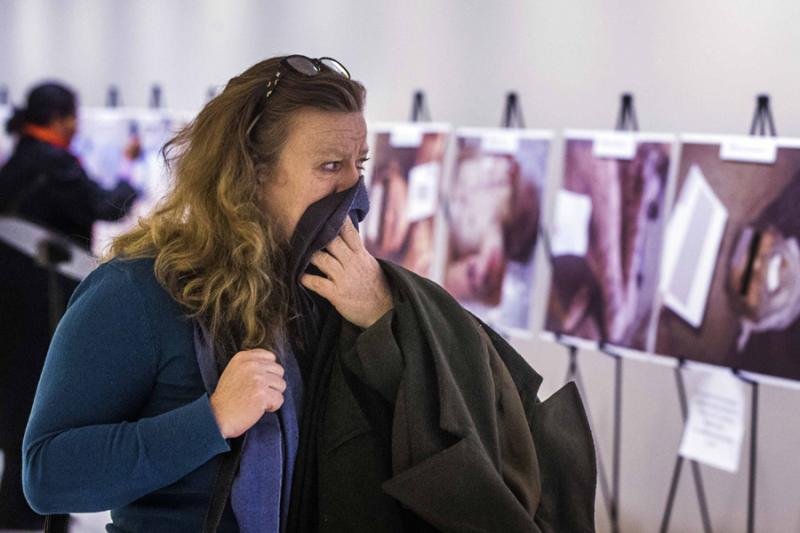
A woman reacts as she looks at images of dead bodies taken by a Syrian photographer code-named "Caesar", at the UN Headquarters in New York
US Congress takes aim at Syrian regime’s war crimes
The US Caesar bill “applies sanctions to those who lend support to the Assad regime’s military efforts in the Syrian civil war".
Wednesday 18/12/2019
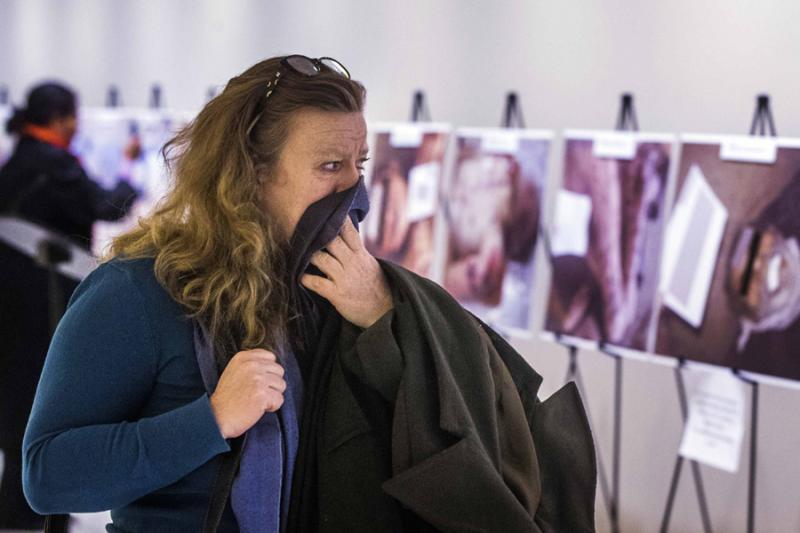
A woman reacts as she looks at images of dead bodies taken by a Syrian photographer code-named "Caesar", at the UN Headquarters in New York
WASHINGTON — US Congress on Tuesday ratcheted up pressure on Syria, Russia and China while making it more difficult for the Trump administration to reduce commitments to allies from Europe to Asia.
As part of a defence policy bill that passed the Senate, lawmakers will impose sanctions on Syrian troops and others responsible for atrocities committed during Syria’s civil war and fund war crimes investigations and prosecutions.
The bill also registered strong congressional concern about Russia and China, will bind the US to supporting Ukraine militarily and bar the Trump administration from any move to recognise Russia’s annexation of Crimea. In addition, it will restrict President Donald Trump’s ability to extract the US from NATO or draw down its troop presence in South Korea.
And, it establishes funding for long-term emergency medical care for more than 40 American diplomats, other government workers and their dependents who were injured in mysterious circumstances in Cuba and China.
Contained in the National Defence Authorization Act is the entire text of the so-called CAESAR Syria Civilian Protection Act, which is named for the former Assad government official who took thousands of photographs of victims of torture and other abuses and smuggled them out of the country.
The Caesar bill “applies sanctions to those who lend support to the Assad regime’s military efforts in the Syrian civil war, and grants authorities to the secretary of state to support entities collecting evidence and pursuing prosecutions against those who have committed war crimes in Syria,” the House Armed Services Committee said.
The law gives the US another means to punish Syrian President Bashar Assad and his allies with sanctions. The US has already imposed sanctions on Assad and a number of his top officials, but the new authority allows foreign companies to be targeted if they are found to be supporting repression.
The US has offered modest support for probes into potential war crimes in Syria in the past. Much of the concern was sparked by Caesar, the codename for a Syrian forensic photographer turned over the images taken between 2011 and 2013 to human rights advocates. His revelations graphically exposed the scale of the Syrian government’s brutal crackdown.
To counter Russian aggression in Europe, lawmakers boosted funding for the European Defence Initiative by $734 million that will pay for military construction on the continent and provide funding for anti-submarine warfare. They also renewed and extended $300 million in security assistance, including lethal weaponry like cruise and anti-ship missiles, for Ukraine.
The bill will also impose sanctions on companies and governments working on the controversial Nord Stream 2 gas pipeline that will link Russia and Germany. US officials believe the pipeline will increase Europe’s reliance on Russian energy.
The act seeks to deter Trump from walking away from the NATO alliance — something his critics fear is his intention — by barring the use of funds “to terminate, suspend, or file notice of withdrawal for the United States from NATO.”
And it will prohibit the Pentagon from reducing the number of US troops in South Korea below 28,500 without a determination from the defence secretary that such a withdrawal is in the national security interest.
Assad regime bombardment kills 23 civilians in northwest Syria
Syrian regime air strikes and artillery fire on Tuesday killed 23 civilians in the last major opposition bastion in the northwest of the country, a war monitor said.
Idlib is supposed to be protected by a months-old ceasefire deal to prevent a broad regime offensive, but deadly bombardment has continued.
The Britain-based Syrian Observatory for Human Rights said around 30 were wounded overall, including some in a serious condition.
It said regime artillery fire killed seven civilians from the same family in the village of Talmanas, adding that the wife and three children of a member of the White Helmets rescue organisation were killed in the village of Badama.
On its Twitter account, the White Helmets — a volunteer group that responds to bombings in rebel-held areas — posted a video of a volunteer apparently pulling the lifeless bodies of his family from the rubble of a building.
In the village of Maasaran, regime air strikes killed a further six civilians.
An AFP photographer on site saw a pool of red blood and clothes strewn on the pavement by a shop whose window had been shattered.
“That’s the regime for you,” a resident said, as he helped a shopkeeper pick up some items of clothing.
Pro-government bombardment also led to four other civilians losing their lives in other parts of the bastion, the Observatory said.
Parts of the Idlib region, which is home to some three million people including many displaced by Syria’s civil war, are controlled by Islamist militants.
The Damascus regime has repeatedly vowed to take back control of it.
Pro-government forces launched a blistering offensive against the region in April, killing around 1,000 civilians and displacing more than 400,000 people from their homes.
Moscow announced a ceasefire in late August, but the Observatory says deadly bombardment and skirmishes have persisted.
It says more than 250 civilians have been killed in the region since the deal.
Syria’s war has killed over 370,000 people and displaced millions from their homes since beginning in 2011 with the brutal repression of anti-government protests.
UN Security Council set for showdown over Syria cross-border aid deliveries
For the past six years the United Nations and other aid groups have been crossing into Syria from Turkey, Iraq and Jordan at four places authorized by the UN Security Council to deliver humanitarian assistance to millions of people.
The 15-member council is aiming to extend approval for those operations this week, which UN Secretary-General Antonio Guterres describes as essential.
Russia, however, wants to cut the number of border crossings in half.
A resolution drafted by Belgium, Kuwait and Germany proposes increasing the authorised border crossings to five – by adding a third from Turkey – but Russia has put forward a rival text that would only approve current operations at two Turkish crossings.
When asked on Tuesday if Russia could veto the draft resolution by Belgium, Kuwait and Germany, Russian UN Ambassador Vassily Nebenzia described that text as “unacceptable and inviable.”
“If it so happens that our draft does not pass, this will mean that the mechanism that we have proposed to extend will not be extended,” he told reporters.
A resolution needs nine votes to pass and no vetoes by Russia, China, the United States, France or Britain. Last year Russia and China abstained in the council vote to extend approval for the cross-border humanitarian aid deliveries.
Russia has vetoed 13 council resolutions on Syria since a crackdown by Syrian President Bashar al-Assad on pro-democracy protesters in 2011 led to civil war. Islamic State militants then used the chaos to seize territory in Syria and Iraq.
In a joint statement on Tuesday, Belgium, Kuwait and Germany and their seven elected counterparts on the Security Council expressed support for their draft resolution.
“The consequences of a non-renewal of the mechanism would be disastrous,” the 10 Security Council members, who are each serving two year terms, said. “This is a mechanism that enables life-saving assistance to reach 4 million people in Syria.”
In a December 16 report to the Council, Guterres urged members to extend authorization of the cross-border aid deliveries.
“This aid has staved off an even larger humanitarian crisis inside Syria,” Guterres wrote.
“While I welcome ongoing efforts to scale up humanitarian assistance delivered from inside the Syrian Arab Republic, I reiterate that the United Nations does not have an alternative means of reaching people in the areas in which cross-border assistance is being provided,” he said.
This article was originally published in The Arab Weekly.