

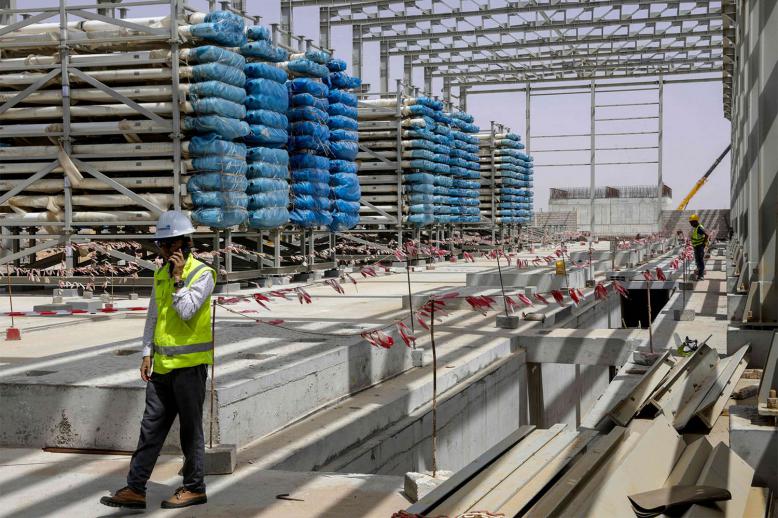

Backbone of potable water supply for millions
Iran threatens Gulf desalination plants, raising humanitarian stakes
In the United Arab Emirates, over 80 percent of drinking water comes from desalinated sources, while Qatar is entirely reliant on desalination.
Tuesday 07/04/2026

Backbone of potable water supply for millions
TEHRAN/WASHINGTON – Iran has issued a stark warning that it could target desalination plants and other critical infrastructure across the Gulf region if the United States follows through on threats to strike its fuel and energy facilities over the closure of the Strait of Hormuz.
The announcement underscores the growing vulnerability of Gulf states, whose populations are heavily reliant on desalinated water to meet basic needs, and highlights the potentially catastrophic humanitarian and economic consequences of escalating regional tensions.
Dependence on desalination
Desalination is not merely an auxiliary water source in the Gulf; it is the backbone of potable water supply for millions. In the United Arab Emirates, over 80 percent of drinking water comes from desalinated sources, while Qatar is entirely reliant on desalination. Bahrain has relied exclusively on desalinated water since 2016, with groundwater kept solely for emergency use.
Kuwait depends on desalination for 90 percent of residential water needs, Oman for 86 percent, and Saudi Arabia, despite its larger reserves of natural groundwater, still derives approximately 50 percent of its water from desalination as of 2023.
Combined, the six Gulf Cooperation Council (GCC) countries, Bahrain, Kuwait, Oman, Qatar, Saudi Arabia, and the UAE, produce roughly a third of the world’s desalinated water and host many of the largest plants globally. Together, their populations exceeded 61 million by 2025, according to United Nations estimates. The region’s reliance on a concentrated network of mega-plants underscores the potential for disruption should hostilities intensify.
Vulnerabilities and strategic risk
The Gulf’s desalination facilities are highly concentrated and often co-located with power generation plants, providing both water and electricity. This dual role, while efficient, amplifies their strategic vulnerability.
Missiles or drone attacks could disrupt water for hospitals, businesses, residences and hotels, while simultaneously causing city-wide power outages.
The Atlantic Council warns that damage to key plants could even necessitate mass evacuations in extreme scenarios.
A 2008 US diplomatic cable revealed that Riyadh would need to evacuate within a week if its Jubail plant, associated pipelines, or power infrastructure were severely damaged.
Preventative measures and strategic reserves
Gulf states have taken steps to mitigate risk.
Saudi Arabia’s Riyadh Strategic Water Reservoir, verified in 2023 by Guinness World Records as the world’s largest drinking water storage facility, ensures the capital can endure temporary supply disruptions.
Qatar, facing extreme summer temperatures exceeding 50°C, constructed 15 massive concrete drinking water reservoirs by 2018, each holding roughly 100 million imperial gallons, equivalent to 180 Olympic-sized swimming pools.
These were recognised by Guinness World Records for being the largest individual tanks and the most extensive network globally.
Mega-plants and global partnerships
Saudi Arabia dominates the regional desalination sector, followed by the UAE and Israel.
The largest plant, Ras Al Khair in Saudi Arabia, cost $7.2 billion and can process 3 million cubic metres of water per day, supplying Riyadh and Hafr Al-Batin.
The Jubail plant, valued at $1 billion, further strengthens the kingdom’s water infrastructure.
The UAE operates four major plants with a combined investment of $5.3 billion, located in Jebel Ali, Taweelah, Fujairah, and Umm Al Quwain.
Israel’s $500 million Sorek plant, near Tel Aviv, provides 20 percent of the nation’s water and was constructed with the help of Singapore-based Hutchison Water.
Unlike some other sectors, US investors are largely absent from Saudi and UAE plants. Germany’s Siemens and France’s Engie contributed to Saudi facilities, while Spain’s Acciona Energia and Belgium’s BESIX Group participated in UAE projects.
Strategic implications
Iran’s warning represents more than a symbolic escalation. Targeting water and energy infrastructure could trigger severe humanitarian crises across the Gulf, with immediate impact on millions of civilians and cascading effects on regional economies.
With the Strait of Hormuz already a flashpoint in global energy markets, any disruption to desalination networks would compound both domestic and international pressures.
As tensions between the US and Iran intensify, Gulf states face the dual challenge of safeguarding critical infrastructure and ensuring water security for their populations in one of the world’s most arid and geopolitically volatile regions.