

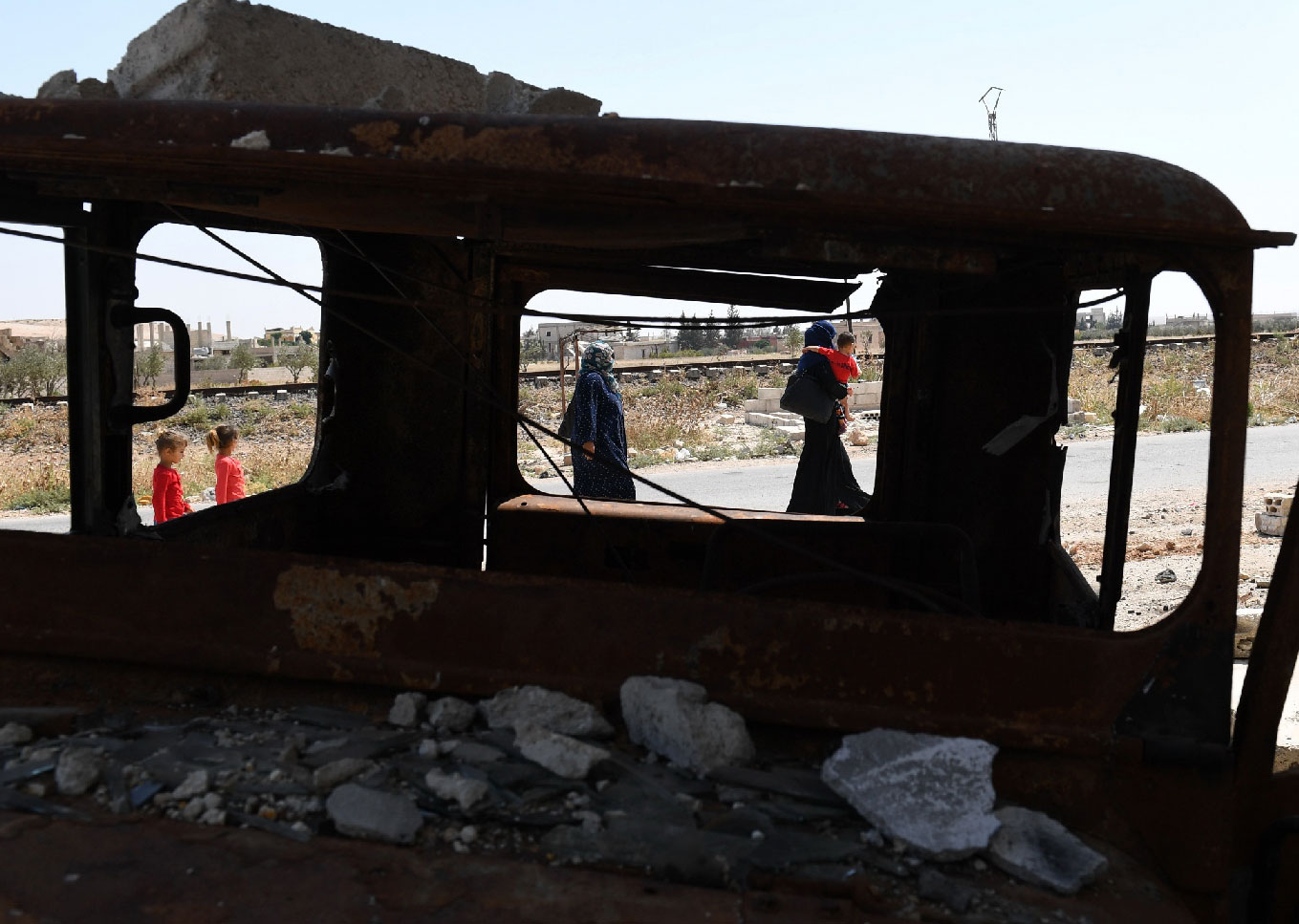
Syrian civilians are seen through a burned vehicle enter the Abu Duhur crossing on the eastern edge of Idlib province.
Russia says Syria rebels planning to 'stage' attack
Moscow's accusation comes after Washington said it will respond "very strongly" if Assad uses chemical weapons in an offensive to retake Idlib.
Saturday 25/08/2018
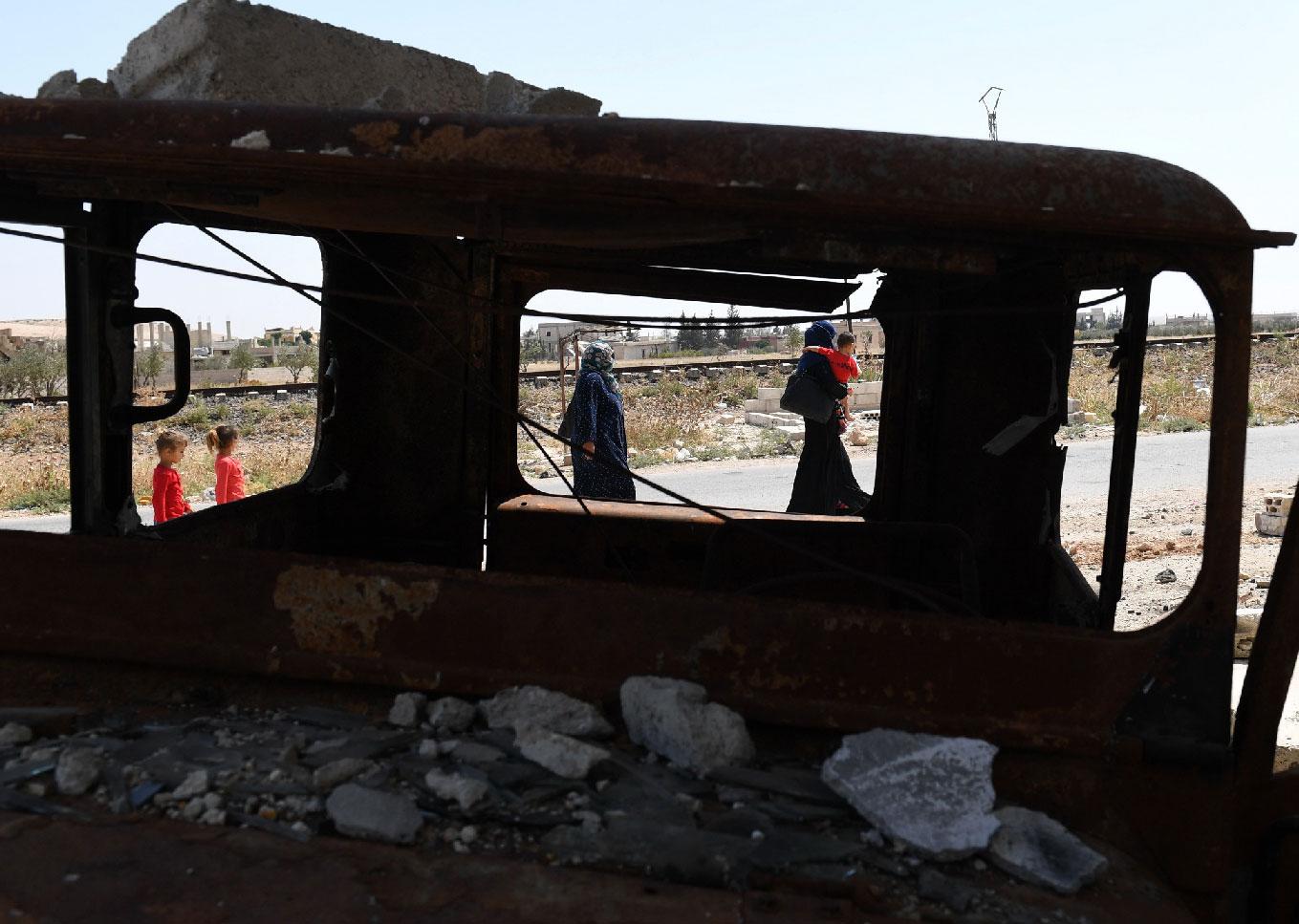
Syrian civilians are seen through a burned vehicle enter the Abu Duhur crossing on the eastern edge of Idlib province.
MOSCOW - Russia on Saturday accused Syria's opposition and its international backers of staging chemical attacks with the intention of blaming them on the Assad regime and its allies, in a repeat of unsubstantiated claims Moscow has made several times throughout the course of Syria's war.
It said Syrian rebels are preparing a chemical attack in Idlib province which will be blamed on Damascus and then used as a pretext for Western powers to hit government targets in the war-torn country.
Moscow's accusation comes after US President Donald Trump's national security adviser John Bolton this week said Washington will respond "very strongly" if Syrian President Bashar al-Assad uses chemical weapons in an offensive to retake Idlib, one of the last rebel held provinces in the country.
Russian defence ministry spokesman Igor Konashenkov said in a statement that the jihadist group Hayat Tahrir al-Sham is "preparing another provocation of the 'use of chemical weapons' by Syrian government forces against the peaceful population of the Idlib province."
He said the group delivered "eight chlorine tanks" to Jisr al-Shughur town in order to "stage" the attack and that these were later taken to a village eight kilometres (5 miles) away.
It was previously assumed that Jisr al-Shughur would be the focus of any regime offensive in Idlib province, the last remaining stronghold of anti-Assad rebels in Syria.
The statement also said a group of militants "trained in handling poisonous substances under the supervision of specialists from the private British military company 'Oliva'" arrived in the town a day earlier.
"The militants have the task of simulating the rescue of the victims of the chemical weapons attack dressed in the clothes of the famous 'White Helmets'," it said.
Unsubstantiated claims
Konashenkov accused British special services of being "actively involved" in the "provocation" which will "serve as another reason for the US, the UK and France to hit Syrian government targets with air strikes."
Accusations from Russia that its rivals are staging events in Syria and spreading 'fake news' is part of a propaganda strategy that parrots the line of the Assad government, which has stated that 'crisis actors' hired by foreign powers and 'terrorists' are being used to stage attacks in the country.
It also frequently claims that pictures of the victims of its brutal bombing campaigns are forged, including a famous photograph of a young, traumatised child in the aftermath of a government airstrike on Aleppo.
Assad’s regime also denied using chemical weapons after being accused of doing so several times throughout Syria's war. Russia's military has previously claimed to have proof that chemical weapons attacks in Syria’s Ghouta region were staged on orders from London.
In March 2018, one month before the attack that injured close to 500 people and killed at least 70 (according to figures from the Syrian Observatory for Human Rights), Russia’s General Staff had accused rebels of planning a “provocation” in Eastern Ghouta with women and children set to play victims of a chemical attack.
However, such accusations have been proven false on several occasions. In one case, Russian state television was found to be publishing images of a film set from 2016 as proof that the White Helmets had staged the Douma chemical attack.
Denial is a key component of Russia and the Syrian regime's strategy in the country's civil war, intended to deflect accusations by governments and rights groups and present their political opponents as biased members of an international conspiracy.
Both France and Britain have accused Russia and Syria of an "obscene masquerade" for such tactics intended to stifle scrutiny of their actions in the war.
Western targets
In April, the US, France and Britain launched joint missile strikes on Syrian targets in response to the chemical weapons attack in Douma that left scores dead.
Russia stuck by its ally Syria and angrily insisted the Douma attack was staged by the White Helmets volunteer rescue service, under "powerful pressure" from the British secret service.
In Jerusalem on Wednesday, Bolton said Washington was "concerned about the possibility that Assad may use chemical weapons again."
"Just so there's no confusion here, if the Syrian regime uses chemical weapons we will respond very strongly and they really ought to think about this a long time," Bolton said.
Speculation is increasing that there could be a Russian-backed government assault on Idlib, one of the so-called "de-escalation" zones set up as a result of talks by Russia, Turkey and Iran last year.
On a visit to Moscow on Friday, Turkish Foreign Minister Mevlut Cavusoglu warned Russia that seeking a military solution in Idlib would be a "catastrophe" before meeting President Vladimir Putin.
Russian Foreign Minister Sergei Lavrov said the situation in Idlib is "multi-faceted" and called for separating out "the healthy opposition from terrorist structures."
Damascus still holds the southeastern tip of Idlib, a strategically important province adjacent to Latakia on the Mediterranean coast that is home to Assad's clan.
More than 350,000 people have been killed and millions displaced since Syria's war started in 2011 with the brutal repression of anti-government protests.