

A strategic vision aimed at consolidating a culture of solidarity
Morocco’s king launches Ramadan operation for vulnerable families
Now in its 28th edition, the programme will oversee the distribution of 34,550 tonnes of essential foodstuffs, including flour, milk, rice, oil, sugar, tomato paste, pasta, lentils and tea.
Monday 23/02/2026
A strategic vision aimed at consolidating a culture of solidarity
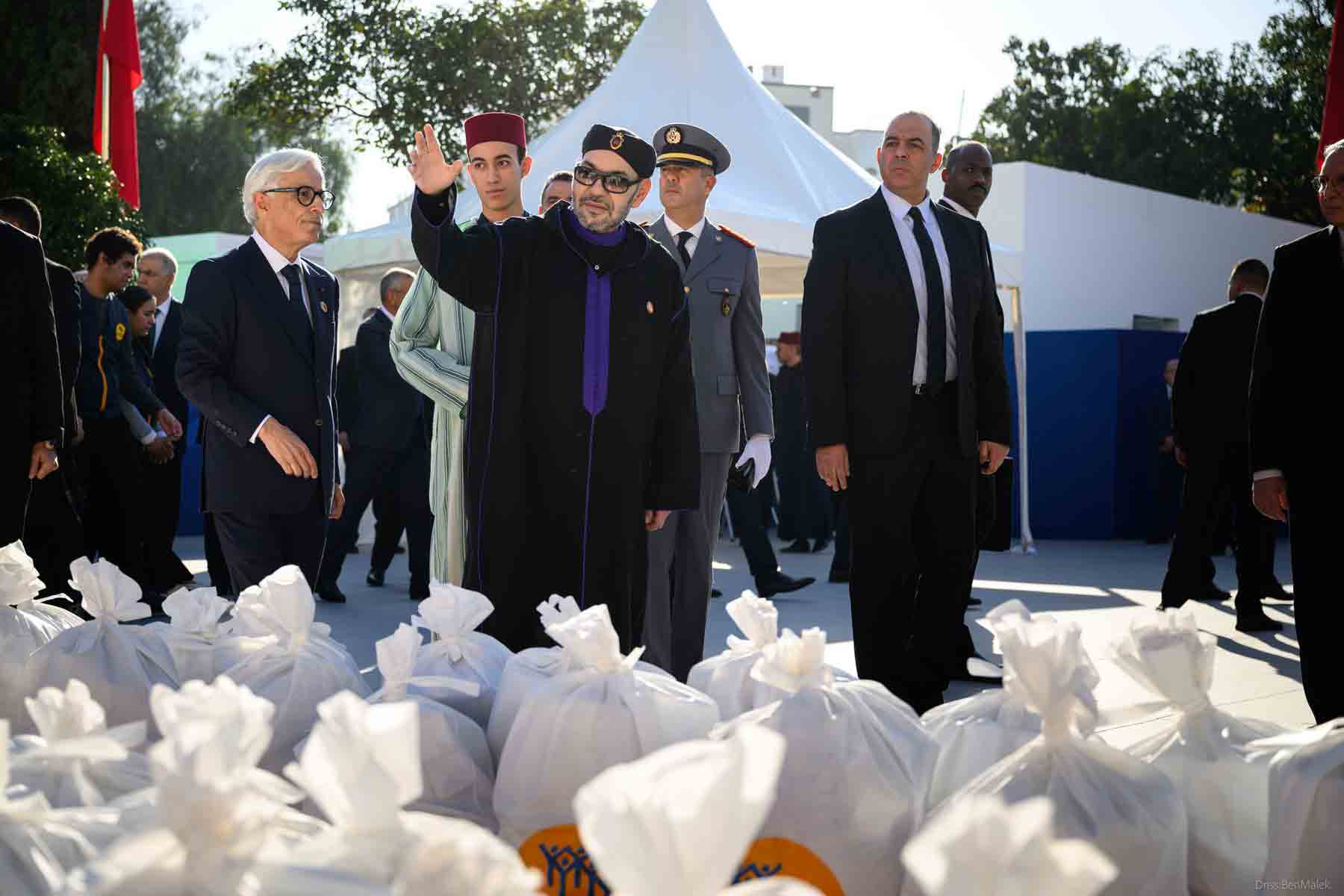
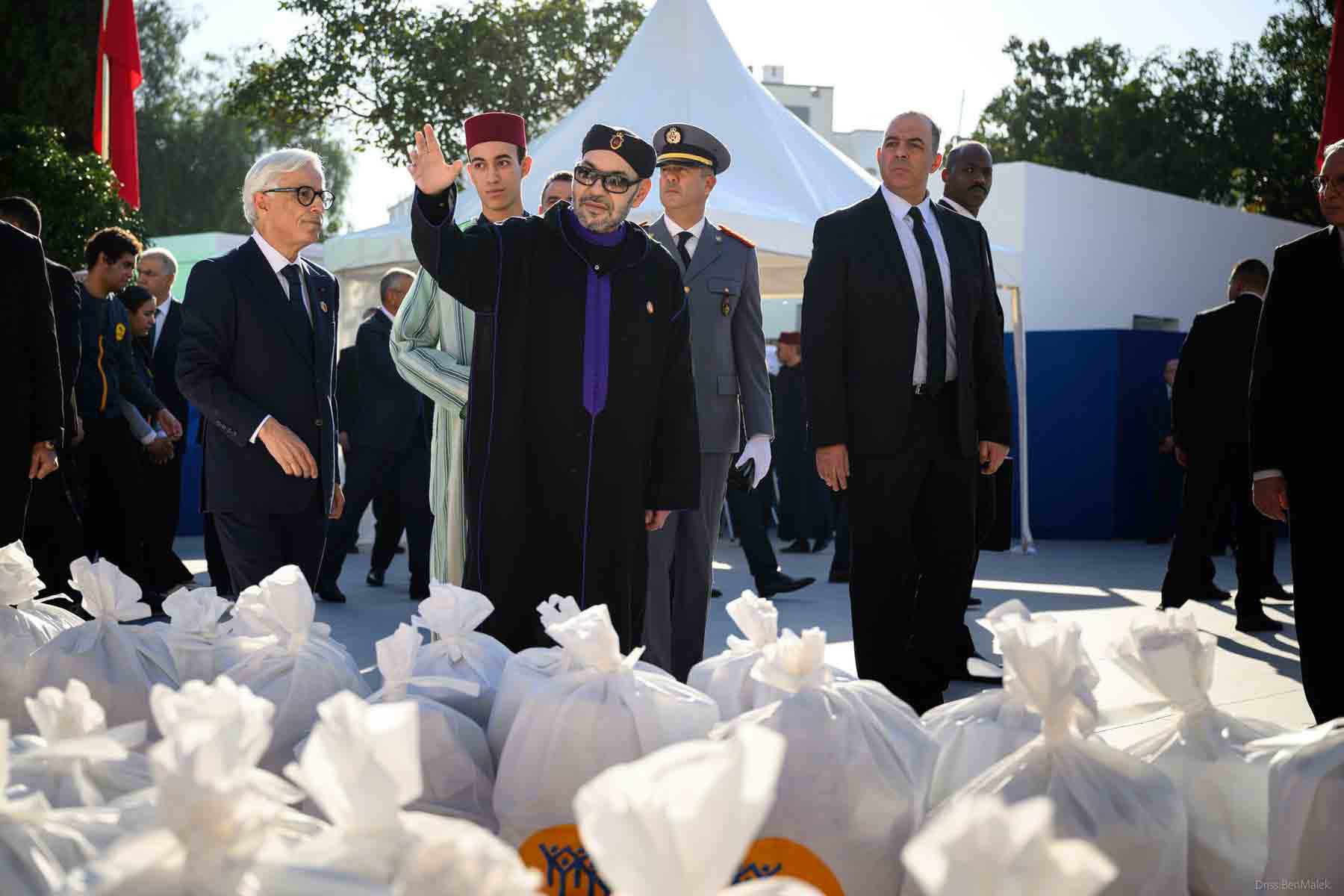
SALE, Morocco – King Mohammed VI, accompanied by Crown Prince Moulay El Hassan, launched on Saturday the national Ramadan 1447 operation in the Al Inbiaate district of Sale, initiating this year’s large-scale food aid campaign aimed at more than 4.36 million people across the country.
The initiative, organised by the Mohammed V Foundation for Solidarity, forms part of a continuing series of royal social programmes with a clear humanitarian dimension. Launched on the eve of the holy month of Ramadan, the operation goes beyond its seasonal character to reinforce solidarity as a long-term institutional and societal commitment.
Now in its 28th edition, the programme has been allocated a budget of 305 million dirhams ($33,5 million) and will oversee the distribution of 34,550 tonnes of essential foodstuffs, including flour, milk, rice, oil, sugar, tomato paste, pasta, lentils and tea. The scale of the resources mobilised reflects a policy approach that seeks not merely to provide temporary relief, but to strengthen social cohesion by integrating the most vulnerable groups into a structured system of social protection.
The operation primarily targets households in precarious circumstances, notably widows, elderly people and persons with disabilities, with the aim of easing living costs and reinforcing food security. According to data from Morocco’s Unified Social Register, which is used to determine eligibility, 74 percent of beneficiary households are located in rural areas, underscoring a deliberate focus on reducing territorial and social disparities.
Among the one million heads of household recorded in the register are more than 432,000 elderly people, 211,000 widows and over 88,000 individuals living with disabilities, figures that offer a detailed snapshot of the social composition of the groups concerned.
For the second consecutive year, beneficiaries have been identified exclusively through the Unified Social Register, based on precise socio-economic indicators. The lists were updated in coordination with services from the Ministry of the Interior, enabling the establishment of a consolidated reference framework designed to ensure accurate targeting and transparency in distribution. The approach is widely regarded as a qualitative shift in the management of social assistance programmes, reducing arbitrariness and enhancing the efficiency of resource allocation.
The initiative is implemented as part of the foundation’s broader humanitarian programme, with financial support from the Ministry of the Interior, the Directorate General of Local Authorities, and the Ministry of Endowments and Islamic Affairs. The institutional partnership reflects coordination across government sectors and public bodies, a factor seen as central to the success of the operation. Aid will be distributed across 1,304 municipalities nationwide.
To ensure smooth implementation, thousands of staff members and volunteers have been mobilised at distribution points throughout the country. They are responsible for delivering food parcels to representatives of beneficiary families. The operation is overseen by provincial and local committees tasked with supervising supply chains, verifying beneficiary lists and monitoring the distribution process on the ground.
A wide range of public institutions are contributing logistical support, including the social services of the Royal Armed Forces, the Royal Gendarmerie, the ministries of agriculture and fisheries, rural development and water and forests and national education, as well as the National Railways Office and the National Office of Electricity and Drinking Water, alongside local authorities and other public bodies.
Quality control is overseen by the National Office for Food Safety in coordination with the Ministry of Health and Social Protection, ensuring that distributed products meet health standards and preserving the dignity of recipients. Officials stress that the humanitarian dimension of the initiative encompasses not only access to food but also guarantees of its safety and quality.
During the launch ceremony, the king symbolically handed food baskets to ten heads of beneficiary families, a gesture underscoring the monarchy’s proximity to vulnerable segments of society. A commemorative photograph was also taken with participating volunteers, highlighting the central role of voluntary engagement in the success of social initiatives.
Since its inception in 1998, the Ramadan food aid operation has mobilised more than 2.5 billion dirhams ($274 million). The number of beneficiary families has risen from 34,100 at the outset to one million since 2023, marking a steady expansion in scope. The upward trajectory reflects the transformation of the programme from a seasonal initiative into a cornerstone of Morocco’s broader social protection system.
Taken together, the figures and institutional mechanisms surrounding Ramadan 1447 point to a strategic vision aimed at consolidating a culture of solidarity and embedding mutual support as a durable feature of Moroccan society. In this sense, the annual operation represents not merely a response to immediate need during Ramadan, but part of a sustained effort to reduce vulnerability and advance social equity through structured, long-term policy.