
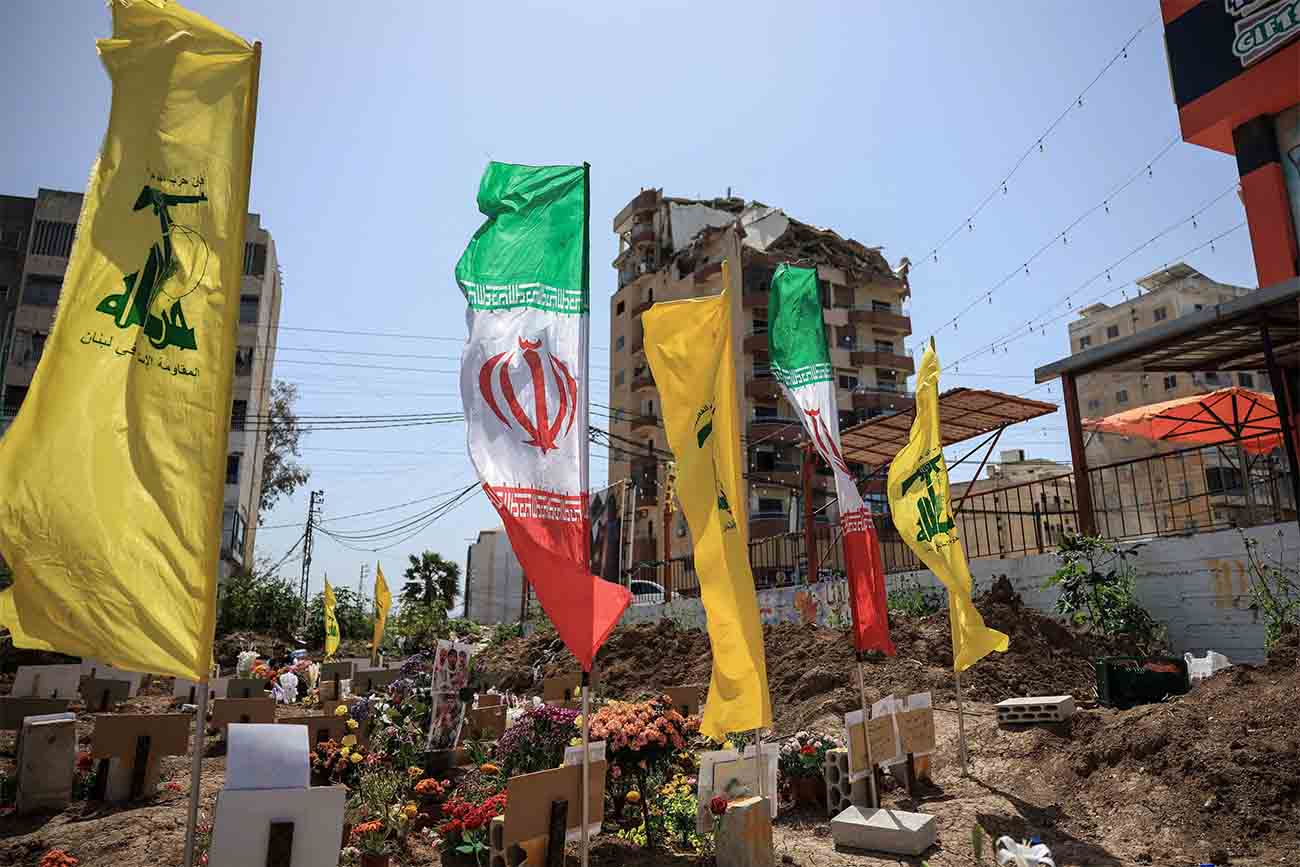
Hezbollah and Iranian flags flutter at a temporary graveyard by a damaged building in Tyre, south Lebanon
Lebanon… between the true patriot and the true traitor
The "Islamic Republic" of Iran refuses to acknowledge that the region has changed and that the role of hegemony it once exercised in the recent past has been relegated to the dustbin of history.
Thursday 30/04/2026
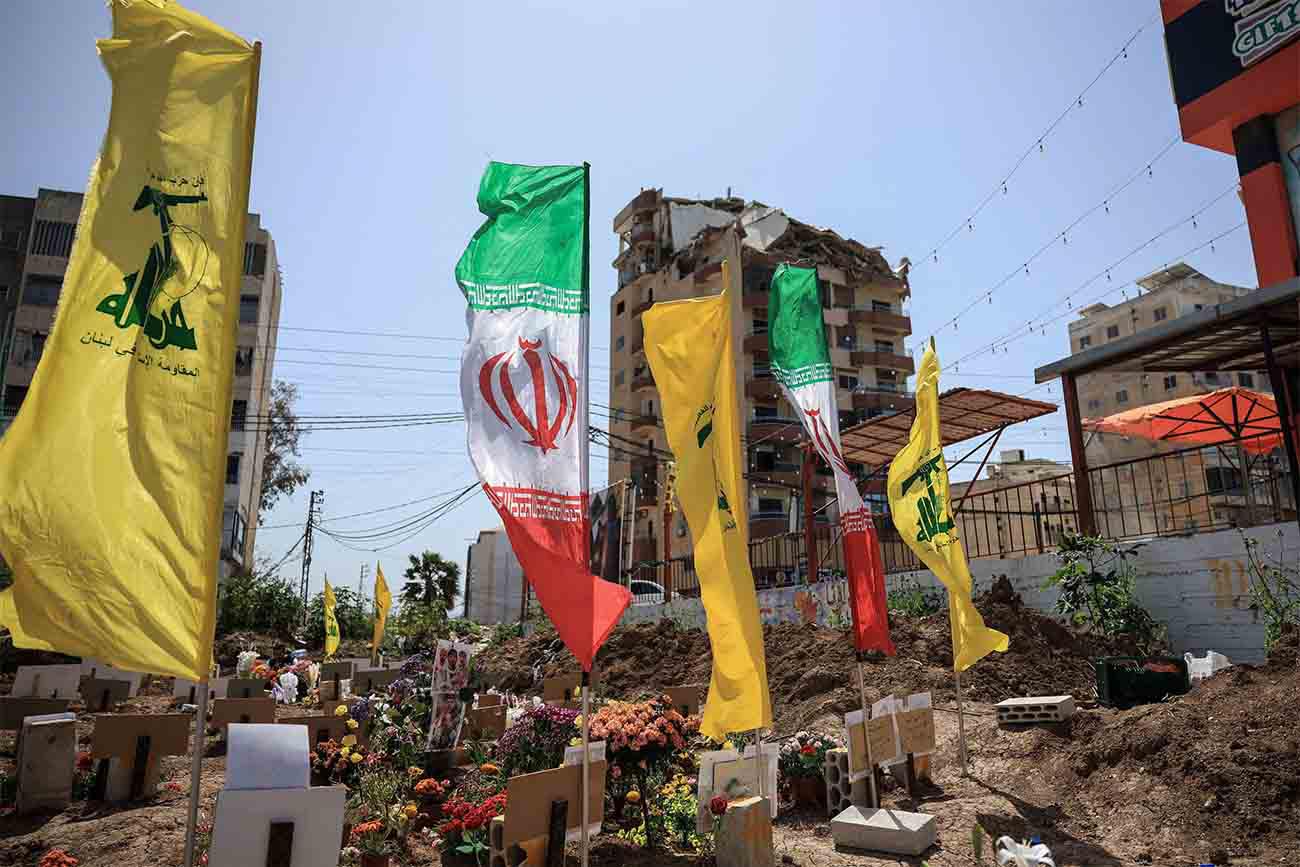
Hezbollah and Iranian flags flutter at a temporary graveyard by a damaged building in Tyre, south Lebanon
Officials in Tehran are unable to accept the new regional and international realities, especially after the "Revolutionary Guard" (IRGC) executed a coup that made it the de facto ruler of Iran and the ultimate arbiter of political and military decisions in the country. The "Guard" also maintains control over the tools it is accustomed to using in Iraq, Lebanon, and Yemen.
Out of an inability to directly confront America and Israel, the "Guard" seeks to consolidate on the ground the results of the coup it also executed in Lebanon—two days after the death of the "Supreme Leader" Ali Khamenei in Tehran on February 28. At that time, the "Guard" did not stop at seizing all the keys to power in the "Islamic Republic." This was followed, on March 2, by the launching of six rockets from southern Lebanon toward Israeli territory, forcing "the Party" (Hezbollah) to claim responsibility for the operation.
The result was the "Yellow Line" imposed by Israel, the near-total destruction of more than fifty southern villages, and the displacement of over a million citizens, most of whom belong to the Shiite community. Because of Iran’s actions, Lebanon faces a genuine catastrophe that must be addressed to avoid a major explosion that would make it impossible to reconstruct the country.
Aoun Calls Things by Their Names
Nothing indicates the decline of the Iranian role—and its impending collapse—more than Lebanese President Joseph Aoun abandoning his reserved stance. Previously, he had worked to avoid a direct confrontation with the Iranian proxy affiliated directly with the IRGC in Lebanon. For the first time, Joseph Aoun is naming things with total clarity. It was significant that he spoke these words before a Sunni-Druze-Christian southern delegation from the Baabda Palace.
The President stated:
"Some hold us accountable for deciding to enter negotiations (with Israel) under the pretext of a lack of national consensus. I ask: When you went to war, did you first obtain national consensus?"
The President added:
"Before the negotiations even began, some started directing arrows of criticism and accusations of treason (takhwin), claiming we were entering negotiations in surrender. We say to them: wait for the negotiations to start and judge by the result. How long will the people of the South continue to pay the price for the wars of others on our land—the latest being the 'Gaza Support War' and the 'Iran Support War'? If the war were for Lebanon, we would have supported it. But when the goal of the war is to serve the interests of others, I reject the war entirely."
The most striking passage in Joseph Aoun’s speech remains: "What we are doing is not treason; rather, treason is committed by those who take their country to war to achieve external interests." Is there any more clarity than this regarding the President's vision of "the Party," its role, and Iran's actions?
What the IRGC has failed to grasp is that Lebanon is forced to deal with the new regional reality rather than flee from it. Lebanon, represented by the President and Prime Minister Nawaf Salam, poses a very simple question: Has the pursuit of reclaiming land become treason, or is treason found in the pursuit of trading in land, displaced persons, and occupation to justify the retention of illegal weapons?
Treason in the Service of an Expansionist Project
Finally, someone in Lebanon has raised the real question about the meaning of treason and who the actual traitor is—the one who placed himself at the service of the IRGC. Practically, the real traitor is the one who put himself at the service of a bankrupt Iranian expansionist project that found no way to defend itself other than involving Lebanon in a war with known catastrophic results.
The President would not have gone this far in the confrontation with "the Party" and its backer, the IRGC, had he not realized that all the Guard’s actions are, on one hand, futile, and that the fate of Lebanon and the Lebanese—including the Shia—is the last thing the Guard cares about on the other.
These futile actions are confirmed by Iran’s behavior in Iraq, which was recently visited by Esmail Qaani, commander of the IRGC's Quds Force. The goals of the visit were not limited to selecting the Guard’s envoy, Ali al-Zaidi (known for his loyalty to Iran), to be the next Prime Minister of Iraq. It went beyond that to inciting certain Iraqi factions—entirely loyal to the Guard—to attack Kuwait using drones launched from Iraqi territory.
The crux of the matter is that Iran has an account it wants to settle with Kuwait because of Kuwait's refusal to allow Iranian participation in the exploitation of the Durra oil and gas field. In March 2022, Kuwait agreed on a partnership with Saudi Arabia to exploit the field, which has absolutely no connection to Iran.
The Effects of the Changes
Despite the massive, existential problems it suffers from, Lebanon is trying to move toward new horizons related to the changes witnessed in the region and the world. The defeat suffered by "the Party" in Lebanon as a result of the "Gaza Support War" is no minor detail. The major change witnessed by Syria and its return to the Arab fold is no minor detail... nor is the world’s forgetfulness of the Gaza tragedy, which sparked the flame of change when Hamas launched the "Al-Aqsa Flood" attack on October 7, 2023.
In the end, it is no minor detail that Lebanon has rid itself of the complex of fear of Iran—the power that killed the noblest of Lebanese, including Rafik Hariri, so that there would be no one in the country who dared to distinguish between the true patriot and the true traitor who brought the Israeli occupation back to the South, destroyed its villages and towns, and displaced its people.