QatarEnergy says it needs to declare force majeure on some LNG contracts
The Qatari company says it is working around the clock with international partners to assess and repair the damaged infrastructure, but production at affected trains remains suspended until further notice.
Wednesday 25/03/2026
DOHA - QatarEnergy said on Tuesday it had determined that it needed to declare force majeure on some of its affected long-term LNG supply contracts, with counterparties including customers in Italy, Belgium, South Korea, and China.
In a brief official statement, QatarEnergy said the declaration covers a portion of its export commitments and takes immediate effect. The company cited “unforeseeable and uncontrollable events” — specifically the physical destruction and ongoing safety issues at key liquefaction trains and associated facilities — as the trigger for invoking the contractual clause that releases it from delivery obligations without penalty.
“Due to the recent attacks on Ras Laffan, QatarEnergy has declared force majeure on certain LNG contracts,” the statement read. “We are working around the clock with international partners to assess and repair the damaged infrastructure, but production at affected trains remains suspended until further notice.”
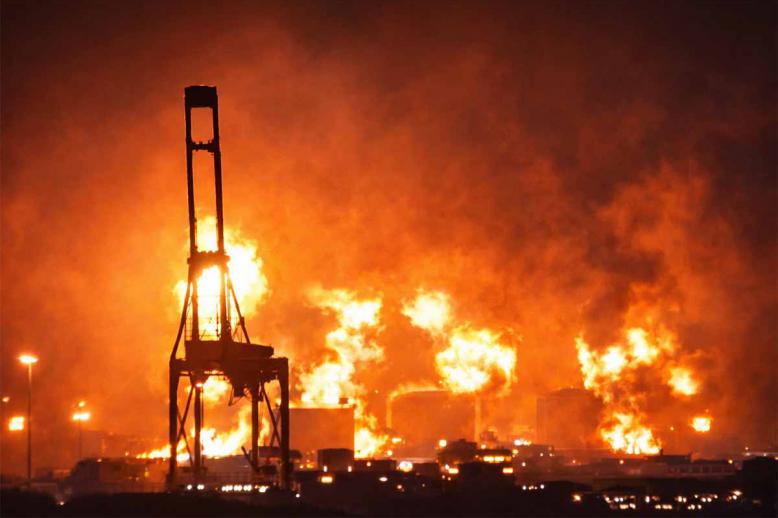
The move comes just days after Iranian ballistic missiles struck the Pearl gas-to-liquids plant and several LNG processing units at Ras Laffan, the single largest LNG export complex on the planet. The facility normally produces around 77 million tonnes per annum, equivalent to roughly one-fifth of global LNG supply. Even partial outages at this scale are expected to tighten markets already strained by the near-total closure of the Strait of Hormuz and earlier disruptions across the Gulf.
Industry sources say the force majeure notices were sent to buyers in Europe, Asia and the Indian subcontinent, including major offtakers in Japan, South Korea, China, India and several European utilities. While the exact volume affected has not been disclosed, analysts estimate it could represent several million tonnes of cargoes over the coming months, depending on how long repairs take.
Global LNG prices reacted instantly. The Asian spot price (JKM) jumped more than 18% in early trading Thursday, while European TTF contracts climbed 12%, extending the rally that began after the first strikes on Ras Laffan. Traders described the market as “extremely tight,” with buyers scrambling for replacement volumes from the United States, Australia and Russia.
QatarEnergy stressed that it is prioritising the safety of personnel and the integrity of remaining operational units. The company has not provided a timeline for full restoration, but senior executives privately indicated that repairs could take “many weeks, if not months,” given the scale of the fires and structural damage.
The declaration marks the most significant force majeure event in the global LNG industry since the 2022 Russia-Ukraine crisis and underscores the direct spillover of the US-Israeli war on Iran into worldwide energy markets. Qatar, which has repeatedly emphasised it is not a party to the conflict, described the Iranian attacks as a “flagrant violation of sovereignty” and has already expelled Iranian military and security attachés in retaliation.
For buyers, the force majeure adds another layer of uncertainty at a moment when the world is already grappling with the worst energy crisis in 40 years. European governments, meeting in emergency session in Brussels this week, are expected to accelerate plans for strategic reserve releases and accelerated diversification away from Gulf supplies.
QatarEnergy said it remains “fully committed” to honouring contracts once operations resume and will work with affected customers on alternative arrangements where possible. However, with Ras Laffan accounting for the majority of Qatar’s flexible LNG volumes, the shortfall is likely to be felt across the global supply chain for the foreseeable future.