
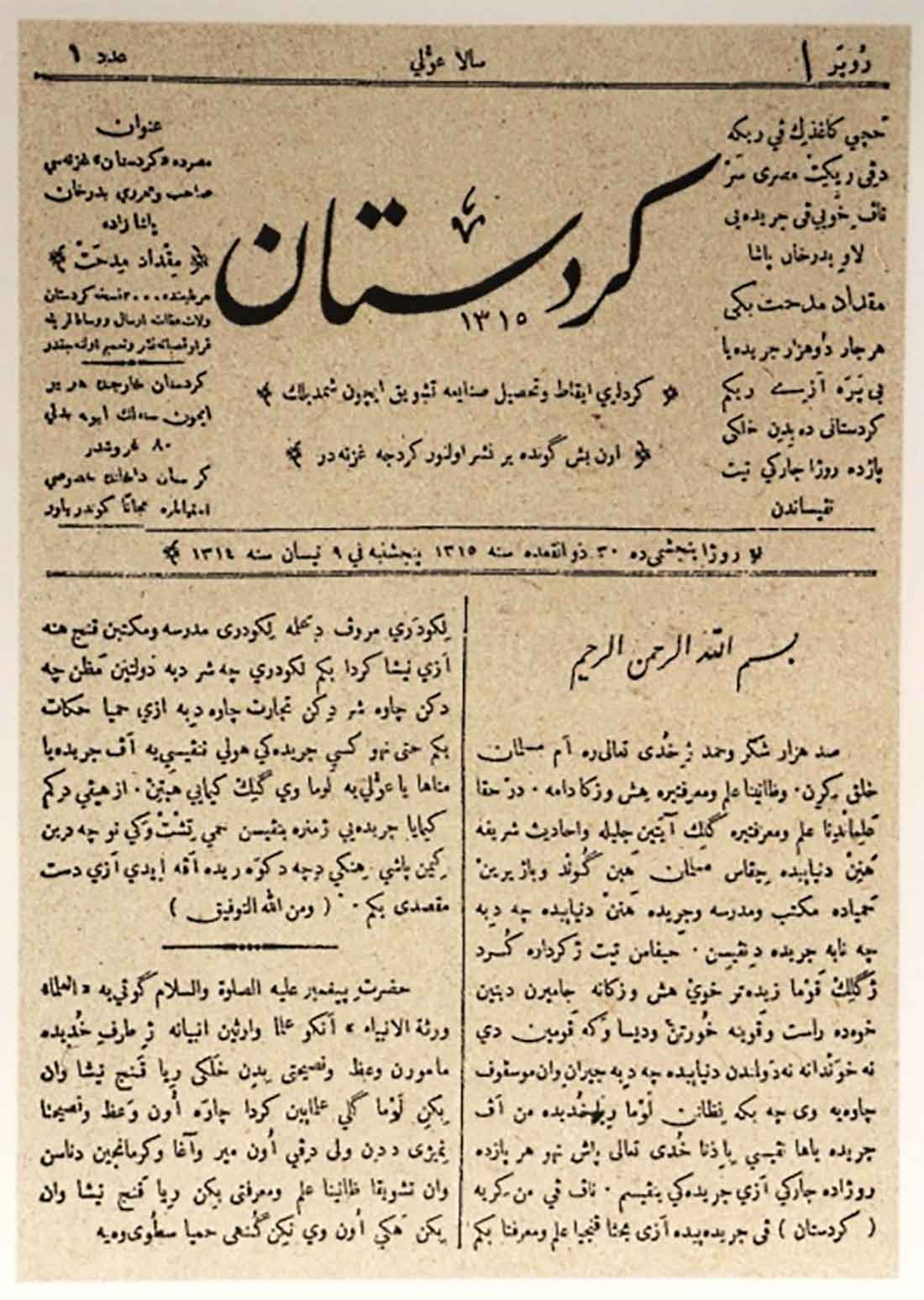
Kurdistan newspaper
On the 128th anniversary of Kurdish journalism
Kurdish journalism has not merely functioned as a medium of information, but has consistently served as a tool for preserving identity and defending rights in the face of political transformations that have not always been fair to the Kurdish people.
Thursday 23/04/2026
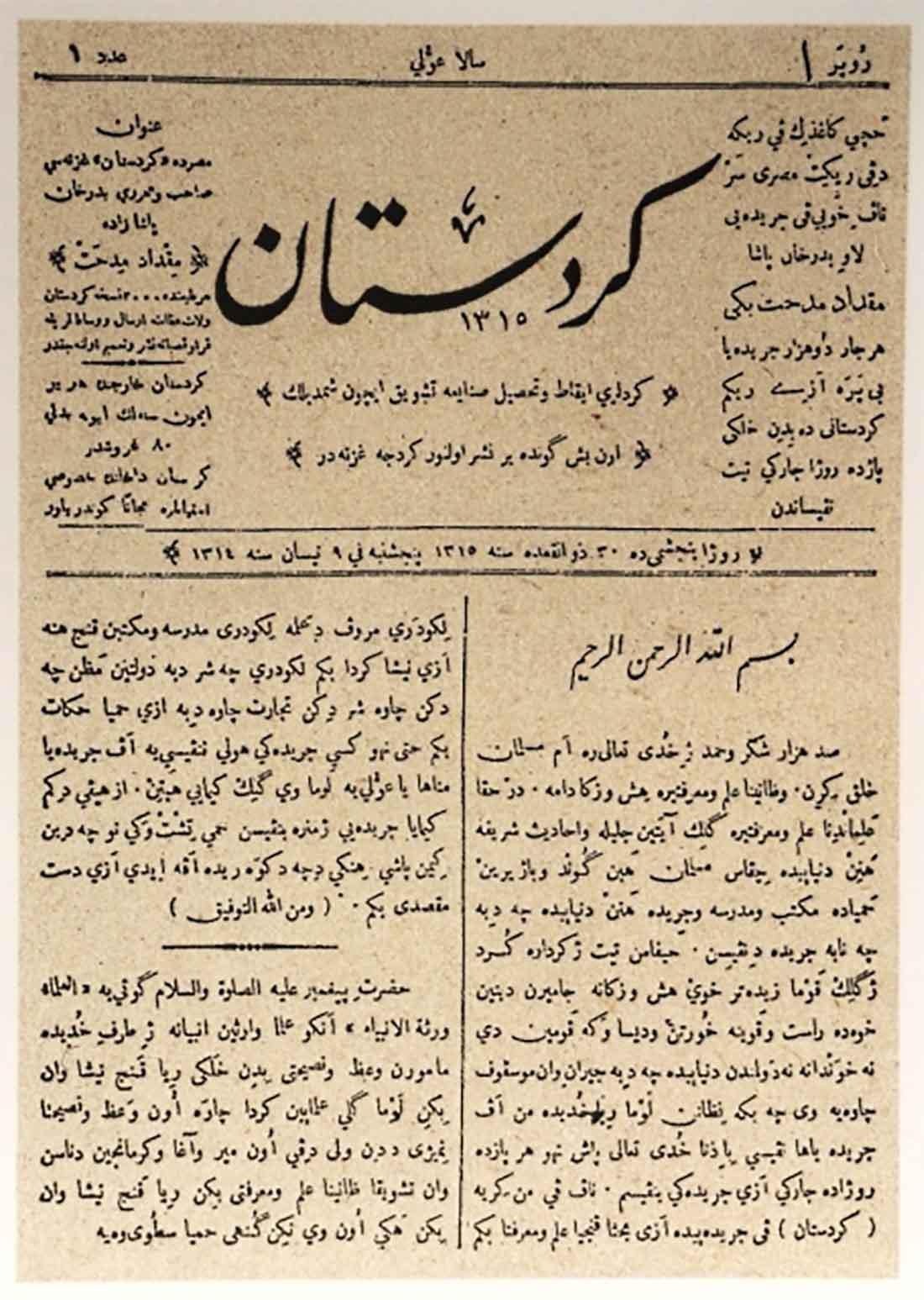
Kurdistan newspaper
Kurdish journalism did not emerge within a stable homeland; rather, it was born in exile. From its earliest beginnings, it maintained an independent orientation, clearly expressing the suffering of its people despite facing exclusion and strict censorship. The first Kurdish newspaper was published in Cairo by the Bedirkhan family, which had been forced into exile from its homeland, making it a form of “exile journalism” imposed by circumstances rather than a voluntary choice.
In this context, the first issue of the newspaper Kurdistan was published on Thursday, April 22, 1898, in Cairo by Miqdad Mithat Bedirkhan. It was a semi-monthly publication printed at Dar al-Hilal Press and secretly distributed to Kurdish regions through Syria. Although this journalism was born in exile, it maintained a strong connection with the Kurdish people, circulating covertly among them, expressing their struggles, and advocating for their legitimate human and national rights.
After the World War I (1914–1918), the region witnessed major political transformations that were, in many respects, not favorable to Kurdish aspirations. This reality directly shaped the trajectory of the Kurdish question and the development of its press. During the era of Sheikh Mahmud al-Hafid, Kurdish journalism experienced notable growth in terms of quantity, quality, and dissemination. The British issued the first Kurdish newspaper, Têgihîştinî Rastî, in 1918, followed by Pêşkeftin in Sulaymaniyah in 1919, then Bangî Kurdistan in 1922, Rojî Kurdistan in November of the same year, Bangî Haq in March 1923, and Omîdî Istiqlal in September 1923. These publications varied between official and private initiatives, covering political, social, and cultural issues, and continued beyond the end of Sheikh Mahmud’s era to the present day.
Kurdish society is considered a politically aware society, striving to uncover facts, particularly in the political sphere, through engagement with various media outlets. The Kurdish people have closely experienced political transformations, with successive generations witnessing different phases of the region’s political evolution. It is therefore common to find members of the same family who have lived through multiple Kurdish movements. This accumulated experience has continued with newer generations, creating a strong connection between the public and regional politics, with media serving as an extension of this awareness, especially with the advancement of information technologies and the diversity of sources.
However, this does not imply that Kurdish society holds a unified opinion. Rather, it is characterized by diverse perspectives and viewpoints. Differences exist among individuals and groups, but through discussion, dialogue, and access to varied sources of information, opinions gradually mature into more refined positions, reflecting a collective process of intellectual interaction.
Public opinion in Kurdistan is not static; it evolves in response to changing events and circumstances. This has been evident in the positions adopted by various Kurdish political parties in their dealings with successive Iraqi governments. In this sense, national interests often serve as the primary driver behind differing stances, more so than traditions, beliefs, or cultural factors.
Thus, Kurdish journalism has not merely functioned as a medium of information, but has consistently served as a tool for preserving identity and defending rights in the face of political transformations that have not always been fair to the Kurdish people.
Dr. Suzan Amedi